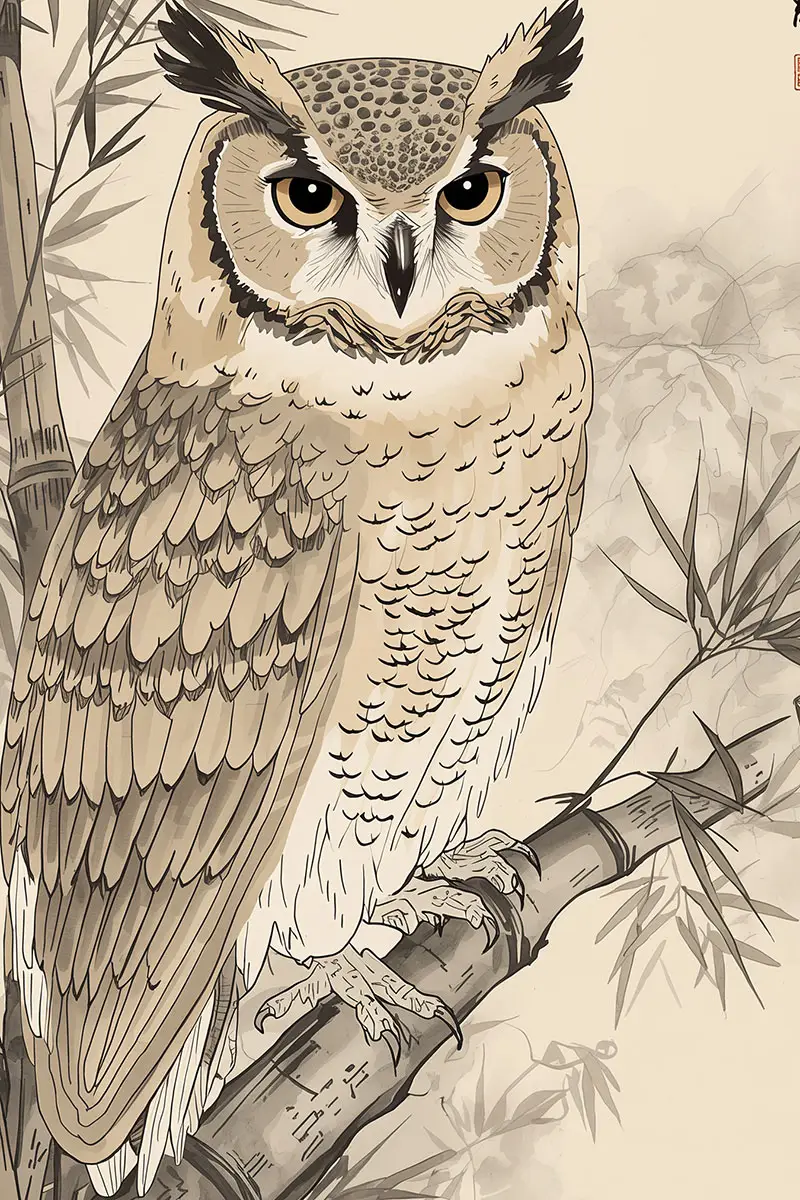
The Owls
The Cultural Significance of Owls
Owls have long captivated human imagination, appearing in our oldest art and stories as mysterious denizens of the night. Across time and cultures, these nocturnal birds have been revered as wise guardians, feared as omens of death, and associated with magic and mystery. The following sections explore the rich tapestry of owl lore from its ancient genesis to modern pop culture, illuminating how the symbolism of owls has evolved yet endured through the ages.
The Genesis: Early Myths and Origins
Human fascination with owls dates back to prehistory. In fact, some of the earliest known depictions of owls are found in Upper Paleolithic cave art. For example, a 13,000-year-old cave painting in France (at the Les Trois Frères cave) portrays several owls, indicating that people in the Ice Age were already intrigued by these birds. Such ancient artwork suggests that owls held significance for early humans, likely due to their eerie calls and nocturnal habits which stood out against diurnal life.
As civilization dawned, owls took on mythic roles in the earliest written traditions. In ancient Mesopotamia, they were linked to the realm of darkness and the supernatural. The Sumerians referred to the owl as ukuku, and an early Sumerian myth curses a city by wishing that owls inhabit its ruins. Mesopotamian folklore connected owls with Lilith, a demon or night spirit; a famous Babylonian plaque (the “Queen of the Night”) even shows a goddess-like figure flanked by owls, hinting at their association with the night and the underworld. In the ancient Near East more broadly, owls were potent symbols of desolation and death – they were creatures said to haunt abandoned places and ruins.
Owls also left their mark in ancient Egyptian culture. Egyptians included the owl in their hieroglyphic writing (the owl sign stood for the sound m), and through a linguistic coincidence it became connected to the word for “death” (mwt). Archaeologists have even found mummified owls in Egyptian tombs, suggesting these birds had ritual or symbolic importance in funerary practices. Although no Egyptian deity was an owl, their presence in tombs implies that owls were associated with the afterlife or protective magic for the dead.
Owls in Myths Around the World
Stories about owls appear on every inhabited continent, with each culture weaving its own beliefs around these nocturnal birds. In some traditions, owls are noble and wise; in others, they are ominous and eerie. Below are examples of owl legends and folklore across various cultures:
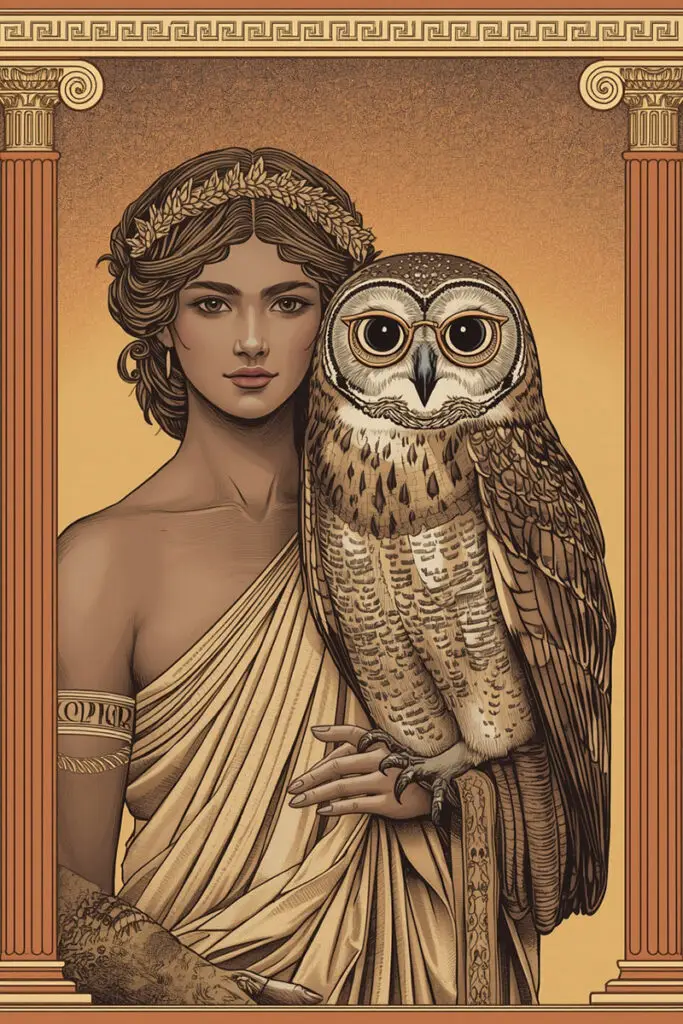
Ancient Greece & Rome: In classical antiquity, the owl was a symbol of wisdom and protection. The Goddess Athena, patron of Athens and deity of wisdom, was closely associated with a little owl (Athene noctua). Athenians believed a mystical “inner light” in the owl’s eyes granted it night vision, and an owl flying over Greek soldiers before battle was taken as a sign of victory. Owls were so revered that Athens featured Athena’s owl on its coins as a protector of commerce. By contrast, the Romans (and later Europeans) often viewed owls more darkly. Roman folklore held that hearing an owl’s hoot predicted imminent death, and Romans would nail a dead owl to a door to ward off evil. Several Roman authors noted that owls foretold the deaths of notable figures like Julius Caesar and Augustus. Roman myth also contains a cautionary tale: Ascalaphus, a figure in the Persephone myth, was transformed into a screech owl as punishment for delivering bad news, cementing the owl’s reputation as a bearer of ill omen.
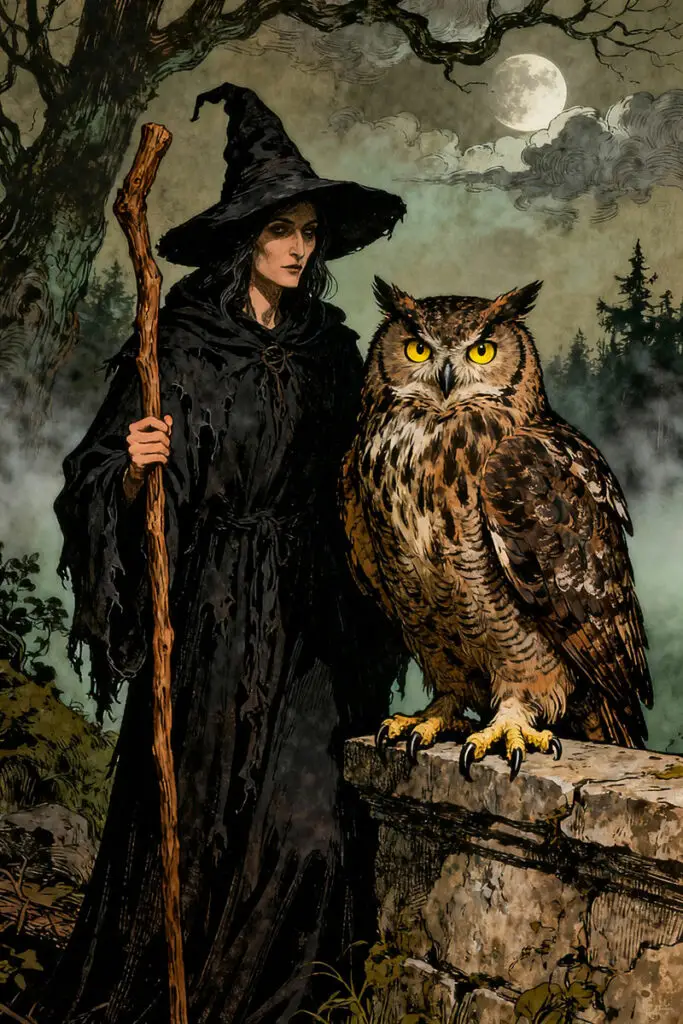
Medieval & Early Modern Europe: Building on the Roman superstitions, Medieval European folklore cast owls as creatures of the occult and doom. Owls were thought to be witches in disguise or their familiars, flying at night to cast spells. An owl’s presence near a village, or its screech heard from a window, filled people with dread, it meant a witch was nearby or that death was approaching. In England, the barn owl’s ghostly appearance and screech earned it the nickname “bird of doom” in poems, and people believed that if an owl circled a house three times, it would herald a death in the family. Well into the 18th and 19th centuries, rural folk practices included nailing owls to barn doors to avert lightning and evil. Such macabre customs underscore how deeply the owl’s ominous image had rooted itself in the European psyche by this time.
India: In South Asia, owls have a dual legacy of auspiciousness and foreboding. In Hindu mythology, the goddess Lakshmi (deity of wealth and prosperity) rides an owl as her vahana (sacred vehicle). This white owl, often depicted beside Lakshmi, symbolizes wisdom, vigilance, and prosperity – the owl’s ability to see in darkness represents insight that pierces ignorance. Because of this divine association, owls in many Indian folktales are considered helpful and wise, credited with powers of prophecy or good luck. However, there’s also a contradictory superstition: hearing an owl’s call is sometimes viewed as an ill omen in India, perhaps foretelling bad luck or even death. This stark contrast illustrates the owl’s complex role in Indian culture, revered in a religious context yet regarded warily in folk belief.
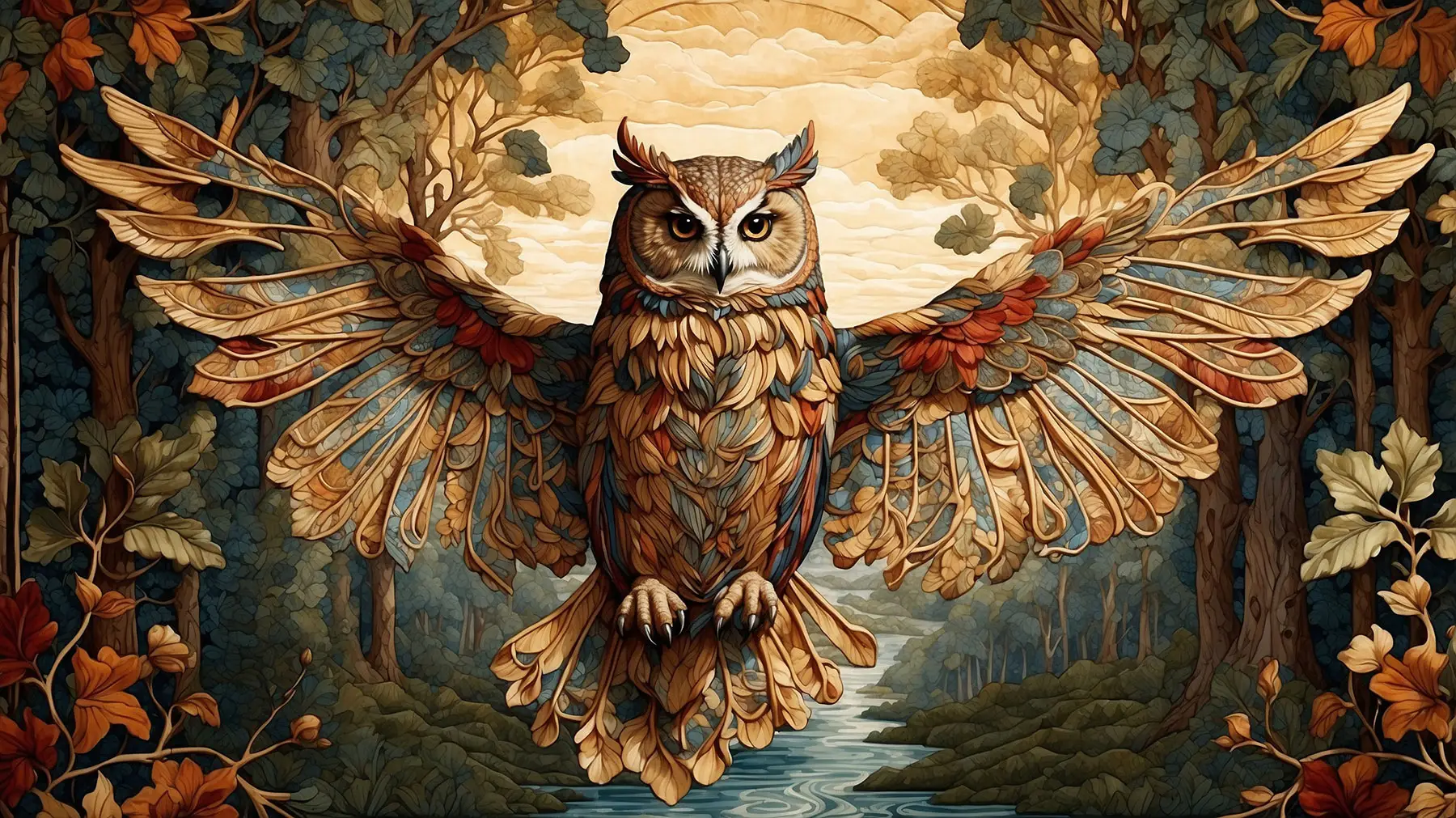
Legends in Asia
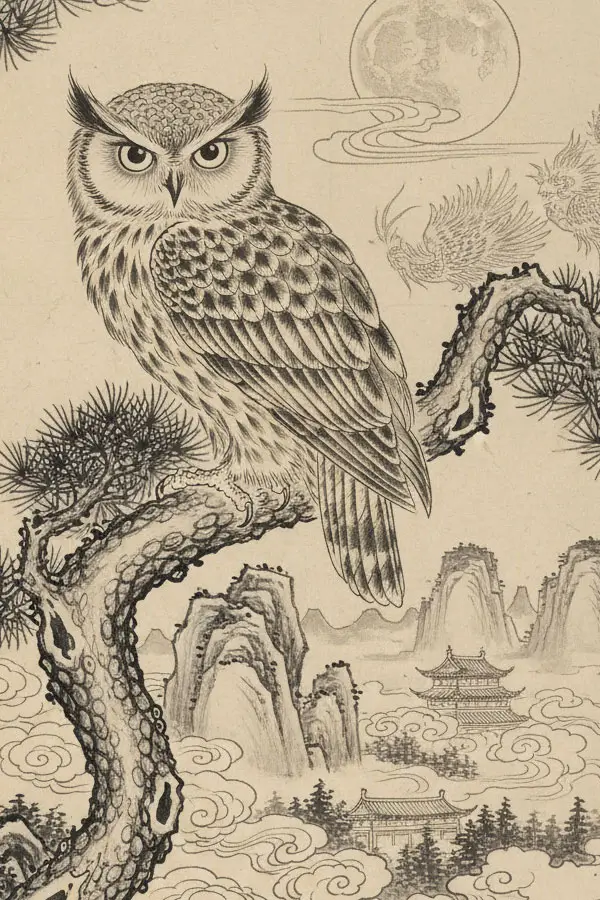
China and East Asia: Traditional Chinese folklore tends to regard owls with fear and respect. In China, the owl was historically seen as a creature of ill omen or evil, sometimes called the “bird of hardship.” Its hoot was believed to predict storms or even the death of someone who heard it. In mythology, one legend claimed that owls were so ferocious that young owlets would gouge out their mothers’ eyes, a story that reinforced their fearsome image. On the other hand, the Chinese also used stylized owl images as protective symbols: bronzeware from ancient China often features owl motifs, possibly to guard against evil spirits. In certain contexts, owls were thought to aid soldiers in battle (due to their fierce nature) and were used as emblematic charms for military success. Meanwhile in Japan, owls (fukuro in Japanese) have been both feared and loved. In early Japanese folklore, owls were ominous birds connected with death or said to be servants of forest demons. But in modern times, Japan has embraced owls as good luck symbols, partly thanks to wordplay (in Japanese fukuro can be written to mean “no hardship”). Today one might see cute owl charms sold as talismans for luck and protection in Japan, showing how a once-negative legend can turn positive over time.
Myths in other parts of the world
Africa: Many African cultures traditionally view owls with caution, often linking them to witchcraft or death. For example, among the Kikuyu people of Kenya, seeing or hearing an owl was believed to foreshadow a death in the community. Throughout parts of Africa, owls are commonly thought to be messengers of sorcerers or spirits. A folk belief in countries like Cameroon and Nigeria holds that witches can shapeshift into owls to fly at night and cast curses. However, not all African owl lore is negative: some societies also recognize the owl’s hunting prowess and keen vision. Still, as a whole, the owl’s reputation in African legends leans toward the mysterious and the dangerous, reflecting the continent’s traditional concern with malevolent spiritual forces after dark.
Native American Traditions: Indigenous peoples of the Americas have diverse owl legends, but a common theme is the owl as a spiritual messenger, often a bearer of warnings. In many Native American cultures, owls are associated with death or the afterlife. For instance, Cherokee folklore uses the same word for “great horned owl” and “witch,” and stories tell of witches transforming into owls to spy on or harm people. Hearing an owl’s screech was (and sometimes still is) said to portend death or misfortune, leading some communities to tell misbehaving children, “Stay inside or the owls will carry you away.” In the Apache and Seminole traditions, owl hoots are indeed regarded as bogeyman calls that warn children to obey elders or face peril in the night. Among tribes of the Southwest and Great Plains, owls are often seen as embodied spirits of the dead or as messengers from departed souls. These examples show that Native stories about owls range from cautionary tales of supernatural danger to reverence for the owl’s survival skills and spiritual guidance.

Creatures of the night
From Europe to Asia to the Americas, owls populate an astounding variety of legends. Yet, across this cultural kaleidoscope, a few common threads emerge. Owls are almost always connected to night and the unknown, given their nocturnal nature. Many societies, fearing what lurks in the dark, painted the owl as a creature of ill omen or a companion to spirits. At the same time, the owl’s keen vision and serene demeanor also impressed people, leading others to cast it as a symbol of wisdom, protection, or divine insight. This duality – wise guide in some stories, harbinger of doom in others – makes the owl one of the most fascinating and interpretable creatures in world folklore.
Owls in Contemporary Culture and Geekdom
In the modern era, owls have transformed from creatures of legend into icons of popular culture. Thanks to their enduring symbolism, owls appear frequently in literature, movies, art, and even as mascots or internet favorites.
Literature: Owls feature in many beloved stories and fantasy novels. Perhaps the most famous is Hedwig, the snowy owl from J.K. Rowling’s Harry Potter series. As Harry’s pet and mail-carrier, Hedwig introduced a generation of readers to the idea of owls as loyal, magical companions.
Film and Television: In films, owls often serve as visual shorthand for mystery or wisdom. Outside of the literary adaptations mentioned above (such as Harry Potter films , many movies use an owl cameo to set a mood. A lone owl hooting in a horror or Halloween movie instantly creates an eerie atmosphere, tapping into the age-old association with darkness. In fantasy cinema, owls sometimes actively participate: the 1981 film Clash of the Titans famously featured Bubo, a mechanical owl given by Athena to aid the hero Perseus, a direct nod to the Greek mythos of Athena’s helpful owl. More recently, Zack Snyder’s animated film Legend of the Guardians: The Owls of Ga’Hoole (2010) brought owl heroes to the big screen with stunning realism, introducing audiences to a whole society of owls with different cultures and roles
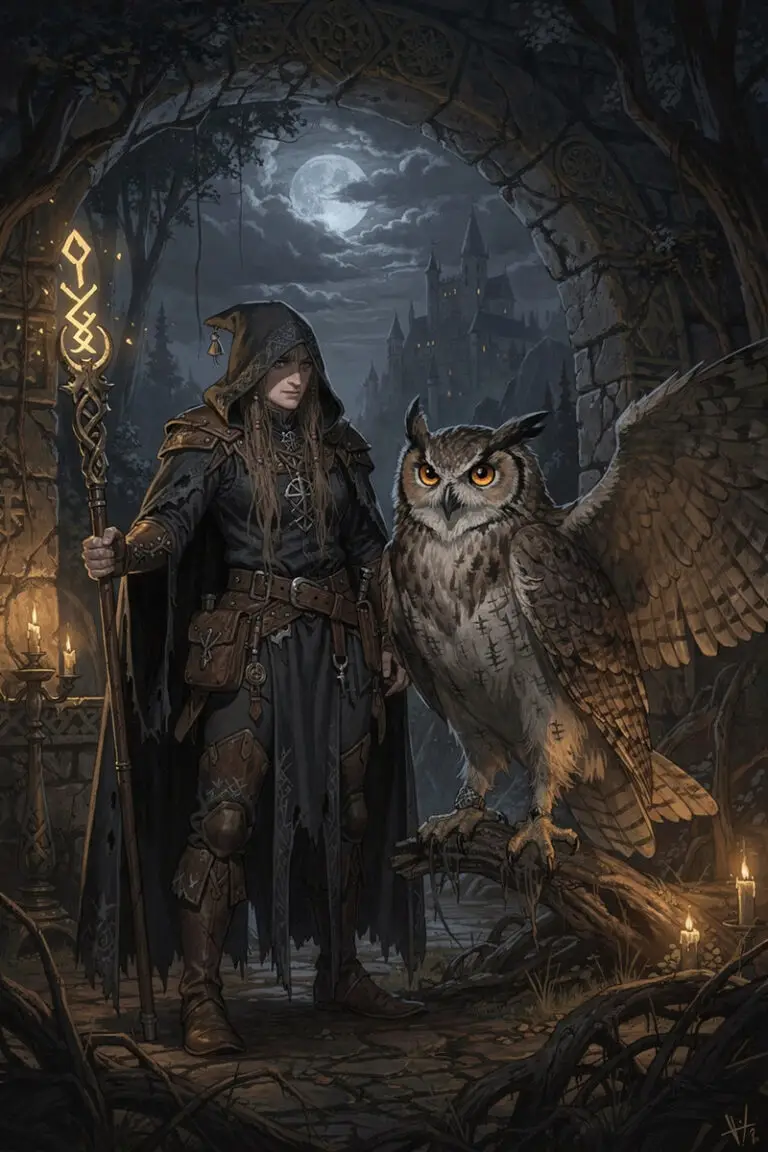
Gaming and Geek Culture: Owls have also swooped into video games, tabletop games, and general geek culture as emblematic creatures. In fantasy role-playing games like Dungeons & Dragons, owls are commonly featured as wizard familiars, small companion animals that lend their masters enhanced perception (a direct play on the owl’s keen senses).
Video games frequently include owl characters, often as guides or wise elders. In The Legend of Zelda: Ocarina of Time, for instance, an owl named Kaepora Gaebora appears at intervals to give the player hints and lore, essentially acting as the hero’s mentor from the shadows. Many Pokémon creatures are owl-inspired too (like Hoothoot and Noctowl), highlighting the owl’s integration into even modern mythologies for kids.
Conclusion
In modern times, we no longer see owls as either all-good or all-evil omens. Instead, they are cherished as captivating, beautiful creatures that carry a bit of ancient mystery on their wings. Whether it’s a barn owl silently gliding over a field or a beloved fictional owl on a screen, these birds continue to inspire wonder. They remind us of our connection to nature’s wild side and the deep well of folklore that shapes how we view the animals around us. The cultural significance of owls, forged over millennia, remains alive and well , a testament to how a small nocturnal bird became a giant of myth and meaning in the human story.