Last updated: July 3, 2026
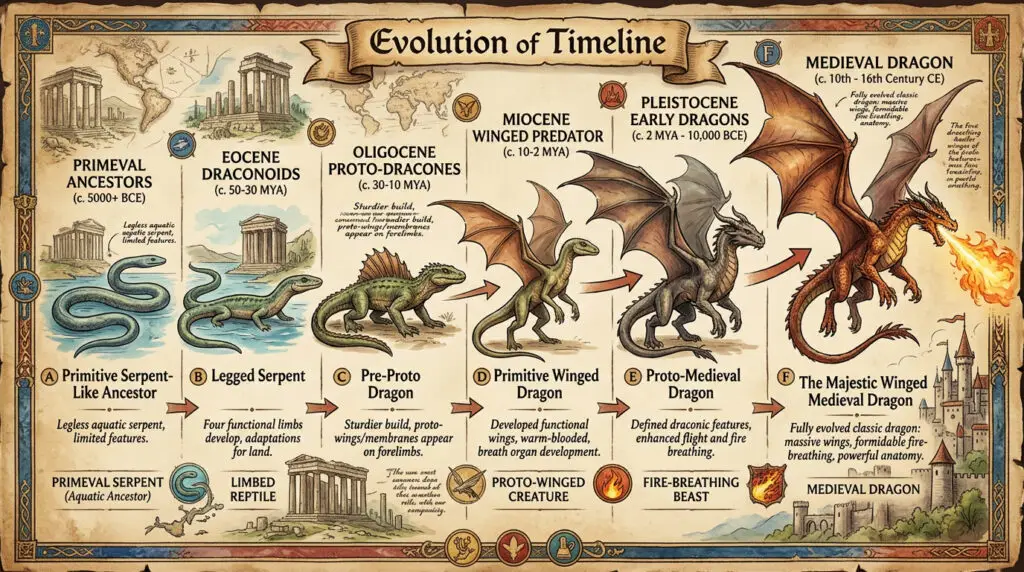
The European dragon myth is the long, layered tradition through which Europe came to imagine the dragon as a powerful serpentine or reptilian creature, often winged, often fire-breathing, often tied to treasure, danger, sacred conflict, or the wilderness beyond human control. In my own field notes, the dragon is best understood not as a single invention, but as a convergence: ancient snake lore, Near Eastern monster imagery, Greek and Roman literary traditions, Christian symbolism, heroic epics, local folklore, and perhaps even the human encounter with large bones and dangerous animals.
What the European dragon is not, at least in historical study, is one uniform beast that appeared everywhere in the same form. The dragon of Greek myth, the dragon slain by Saint George, the treasure-hoarding monster of Beowulf, and the transformed serpent of Norse legend belong to related but distinct traditions. Their family resemblance is real, yet their meanings change with time, religion, geography, and literary fashion.
Why does this matter? Because the dragon sits at the crossroads of folklore, religion, psychology, literature, and material culture. To study the origin of the European dragon myth is to study how societies transform fear into story, story into symbol, and symbol into cultural memory. For readers of a bestiary, this creature is one of the most useful specimens in the whole cabinet.
I will proceed here as both compiler and investigator, with the caution of a natural philosopher and the appetite of an adventurer. The aim is not to invent a fresh legend, but to assemble a reliable manual from existing traditions, academic interpretation, and surviving texts.
Table of Contents
- Overview
- Core Concepts
- How the European Dragon Myth Developed
- Types of Dragon Origins
- Advanced Considerations
- Frequently Asked Questions
Definition and Field Context
If I were to label a specimen drawer in the manor library, I would write this: the European dragon is a mythic composite. It draws from the ancient fear of snakes, the prestige of classical literature, the religious force of Christian allegory, and the medieval love of heroic combat. Across centuries, the dragon became a vessel into which each culture poured its own anxieties (chaos, greed, pagan danger, invasion, wilderness, death, and forbidden knowledge).
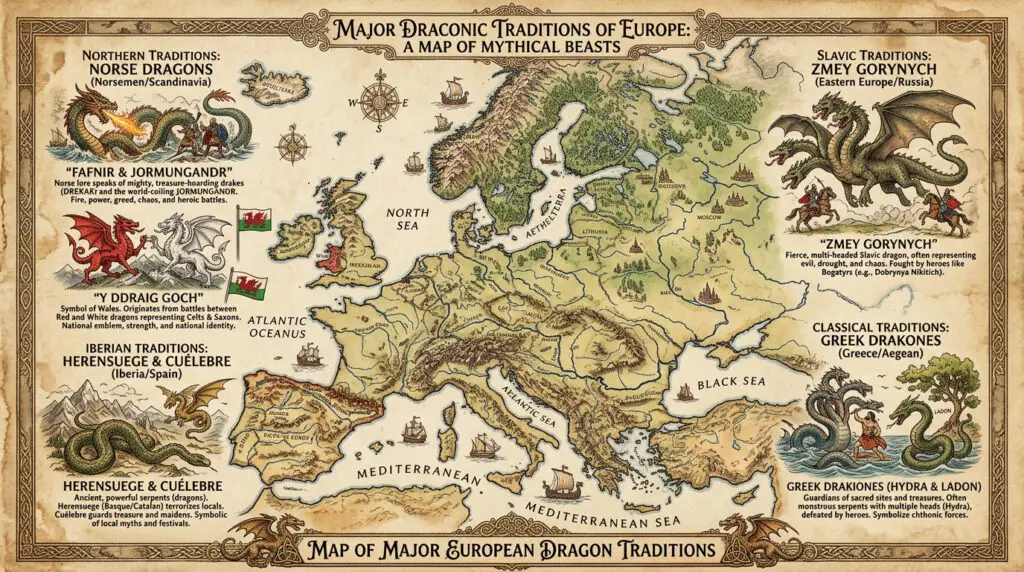
The earliest roots lie not in the familiar medieval winged dragon alone, but in older serpent-monsters: Python in Greek tradition, the Hydra, the dragon guarding the Golden Fleece, and the many dracones or serpentine beings known to Roman authors. Over time, these creatures mingled with northern European tales of worm-like monsters and treasure guardians, then were reshaped by saints’ legends and heraldic art.
Core Concepts
1. The Dragon Begins as a Serpent
One of the first things a serious observer notices is that many early European dragons are not yet the full four-legged, bat-winged beasts of later illustration. In Greek and Roman usage, words related to dragon often referred to a large serpent or watchful snake-like monster. The Greek drakon likely carried the sense of a creature with a deadly stare or vigilant gaze.
This matters because it shows that the dragon’s oldest European form may have been closer to a monstrous snake than a medieval lizard. In classical myth, such beings guard springs, groves, treasures, or sacred boundaries. They are often opponents of gods and heroes, but not always identical in shape.
Example: Python, slain by Apollo at Delphi, is better understood as a chthonic serpent-monster than as the later castle-haunting dragon of romance.
2. Guardianship Is Central to Dragon Identity
A dragon is often defined less by anatomy than by function. It guards something: a spring, a treasure, a threshold, a princess, a kingdom’s fear, or the moral order of a tale. This guardian role appears again and again in European materials.
In heroic literature, the beast’s hoard symbolizes more than wealth. Treasure can represent dynastic memory, social power, temptation, or cursed inheritance. A dragon’s lair is therefore not random scenery; it is a dramatic chamber where desire and danger meet.
Example: The dragon in Beowulf is inseparable from the buried treasure it protects. Remove the hoard, and the story loses much of its moral pressure.
3. Christianity Changed the Meaning of Dragons
As Christianity spread through Europe, older serpent-monsters were not erased; they were reinterpreted. The dragon became increasingly associated with sin, Satan, paganism, chaos, and the enemy of sacred order. Biblical imagery, especially from Revelation, strengthened this symbolic transformation.
That is why medieval dragon stories often place the beast opposite a saint or righteous hero. The battle becomes moral theater. Whether or not a local dragon legend began in pre-Christian folklore, later retellings frequently gave it Christian framing.
Example: Saint George and the Dragon is not only a monster tale. It is also a conversion story, a triumph of sanctity over terror.
4. Northern and Western Europe Added the Hoard-Dragon
Germanic and Norse traditions contributed another major element: the dragon or worm as a greedy, ancient, treasure-bound creature. In these traditions, the monster is not merely wild nature. It is often corrupted power made flesh.
Fáfnir is especially important because he is not born a beast in the simplest sense; he becomes one through greed and violence. This links dragonhood with moral deformation. Such stories helped shape the later European idea that dragons are embodiments of avarice.
5. Images Standardized the Monster
The dragon most people picture today was stabilized by medieval art, manuscript illumination, church carvings, and heraldry. Wings, claws, horns, scales, and fire became increasingly fixed features in visual culture, even when older texts were less precise.
This is a crucial point in myth studies: images often harden what stories leave fluid. Once artists repeat a form across generations, that form begins to feel ancient even if it is partly conventional.
6. Real Animals and Real Bones Likely Helped
No responsible scholar should claim that fossils alone created dragon myths. Still, the possibility that unusual bones, giant skulls, crocodile remains, whale skeletons, or the memory of large predators contributed to dragon lore deserves attention.
Adrienne Mayor and other researchers have argued that fossil discoveries influenced ancient monster traditions in several cultures. In Europe, local finds may not explain the entire dragon myth, but they could have reinforced belief in giant reptilian beings.
Field note: A shepherd who finds a massive jawbone does not require modern paleontology to imagine a monster.
How the European Dragon Myth Developed
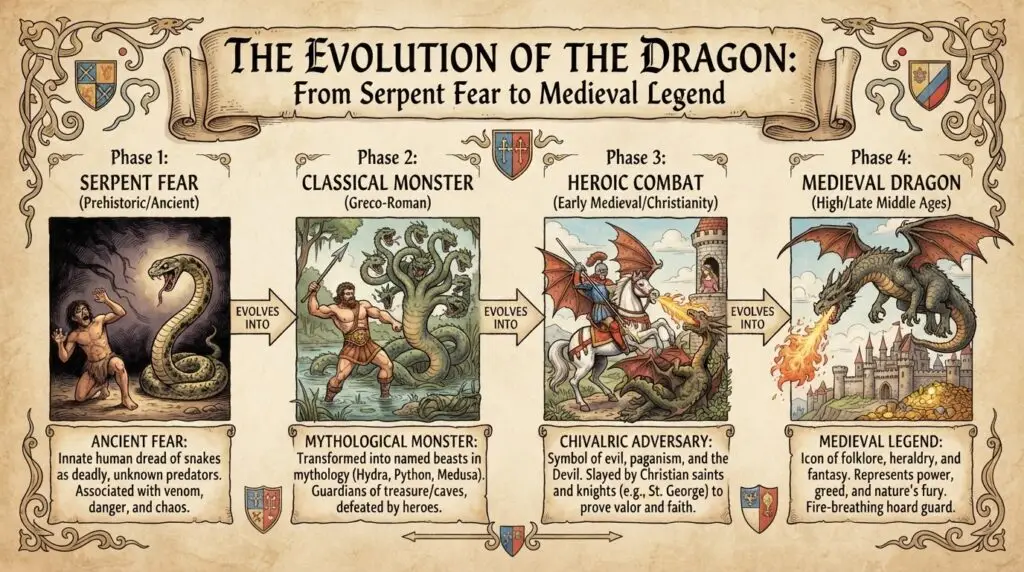
Step 1: Ancient Fear of Serpents and Predators
The foundation is biological and psychological. Humans have long feared snakes, constrictors, venom, ambush, and predation. Many cultures encode this fear in stories of giant serpents.
Input: real danger and instinctive fear.
Process: storytelling magnifies the threat.
Output: supernatural serpent guardians and adversaries.
Step 2: Classical Myth Creates Named Serpent-Monsters
Greek and Roman sources give structure to the fear. Serpents become mythic actors: Python, the Hydra, Ladon, and dragon-like guardians in heroic quests. These creatures are now attached to gods, heroes, shrines, and cosmology.
Step 3: Local Folklore Preserves Regional Beast Traditions
Across Celtic, Slavic, Germanic, Iberian, and other European traditions, stories of worms, drakes, and serpentine monsters persisted. Some were wingless. Some lived in lakes or hills. Some demanded tribute. Others embodied weather, plague, or territorial dread.
Step 4: Christianity Reframes the Monster
Once Christian interpretation dominates literary culture, dragon combat becomes allegorical. Slaying the dragon may symbolize triumph over the devil, heresy, or the old disorder of the land.
Step 5: Medieval Literature and Art Standardize the Beast
Romances, saints’ lives, heraldry, and bestiaries circulate a recognizable dragon type. The dragon becomes more visually consistent and more morally legible. It is no longer merely a local monster. It is an emblem.
Step 6: Later Fantasy Inherits the Medieval Model
Modern fantasy did not invent the European dragon. It inherited and popularized a medieval form already shaped by centuries of storytelling.
Types of Dragon Origins
Not all explanations for dragon origins are of the same kind. In my notes, I sort them into the following categories.
1. Linguistic Origins
These focus on words such as Greek drakon and Latin draco, which point toward serpentine creatures and watchful monsters.
Best for: tracing early concepts
Strength: grounded in texts
Limitation: words shift in meaning over time
2. Mythological Origins
These examine continuity from older serpent-monsters in Greek, Roman, and regional European traditions.
Best for: literary and religious history
Strength: rich narrative evidence
Limitation: hard to prove direct continuity in every case
3. Religious-Symbolic Origins
These explain the dragon’s rise as a symbol of evil, chaos, and spiritual danger under Christian influence.
Best for: medieval studies
Strength: strong documentary basis
Limitation: may understate pre-Christian roots
4. Folkloric Origins
These emphasize village tales, oral tradition, place legends, and regional monster lore.
Best for: local variation
Strength: explains diversity
Limitation: oral traditions are often difficult to date precisely
5. Naturalistic Origins
These point to crocodiles, giant snakes, fossils, and misidentified bones as possible contributors.
Best for: explaining belief reinforcement
Strength: materially plausible
Limitation: rarely sufficient as a stand-alone explanation
Comparison Table
| Origin Type | Best For | Evidence Base | Complexity | Main Risk |
|---|---|---|---|---|
| Linguistic | Early definitions | High | Medium | Overreading word history |
| Mythological | Story development | High | High | Assuming one direct line |
| Religious-symbolic | Medieval meaning | High | Medium | Ignoring older layers |
| Folkloric | Regional forms | Medium | High | Dating uncertainty |
| Naturalistic | Material triggers | Medium | Medium | Overclaiming fossil impact |
Advanced Considerations
For more experienced readers, the most useful question is not “Where did the dragon come from?” but “Why did Europe repeatedly need the dragon?” The answer changes by era.
In antiquity, serpent-monsters often guarded sacred places and dramatized divine conquest over chaos. In the medieval Christian period, dragons helped stage moral conflict in visible form. In heroic literature, they concentrated anxieties around kingship, inheritance, greed, and fate. In folklore, they could represent the dangerous edge of settlement—the cave, the marsh, the mountain, the old ruin.
Another advanced issue is convergence versus continuity. Some dragon traits may descend directly from older traditions. Others may arise independently because different cultures respond similarly to snakes, predation, bones, and the imaginative power of scaled creatures. The safest conclusion is usually layered development rather than single-source origin.
A final note concerns visual culture. Once dragons entered heraldry and manuscript art, they became easier to reproduce than to rethink. This means the dragon’s shape may sometimes tell us more about the artist’s period than about the myth’s earliest stage.
Frequently Asked Questions
Did European dragons come from dinosaurs?
Not directly. There is no evidence that medieval or ancient Europeans understood dinosaurs in a modern scientific sense, though unusual bones may have encouraged monster interpretations.
Were early European dragons always winged?
No. Many earlier dragon-like beings were closer to giant serpents or worms than to the later winged standard.
What is the difference between a serpent and a dragon in old texts?
Often the boundary is fluid. In some periods the terms overlap, while in others dragon suggests a more monstrous, powerful, or symbolically charged being.
Why do so many dragons guard treasure?
Treasure guardianship expresses themes of greed, taboo, kingship, and danger. In heroic literature it turns wealth into a test of character.
Is Saint George the origin of the European dragon myth?
No. The Saint George legend is highly influential, but it is much later than classical serpent myths and other preexisting dragon traditions.
Did Christianity invent dragons as symbols of evil?
It did not invent dragon imagery, but it strongly amplified and standardized the dragon as a moral symbol of evil and chaos.
Are Norse dragons different from classical dragons?
Yes. They overlap, but Norse dragons often emphasize curse, greed, transformation, and hoarded wealth more strongly.
Could fossil discoveries have inspired dragon legends?
Possibly in some cases. Most scholars treat this as one contributing factor rather than the sole explanation.
Why are dragons so common across Europe?
Because the dragon is a highly adaptable symbol. It can absorb local fears, religious ideas, inherited myths, and visual conventions.
What is the most likely origin overall?
The best-supported answer is a layered one: serpent fear, classical myth, regional folklore, Christian symbolism, and medieval art all contributed.