Few monsters in human history have been as universally feared, or as persistently believed in, as the Kraken. For centuries, Scandinavian sailors swore by its existence: an incomprehensibly large creature lurking in the cold depths of the Norwegian Sea, capable of pulling a full-rigged warship beneath the waves with the casual sweep of a tentacle. Today, in May 2026, the world’s most famous sea monster is having one of its biggest cultural moments yet. A Norwegian horror film bearing its name hits theatres on June 12. A major Natural History Museum exhibition dedicated to sea monsters opened this week in London. And a team of international palaeontologists has just published findings suggesting that Kraken-sized cephalopod predators were, once upon a geological time, very real.
This is not a creature that needs rehabilitation. The Kraken has always been here, waiting in the deep. The world is simply surfacing to meet it again.
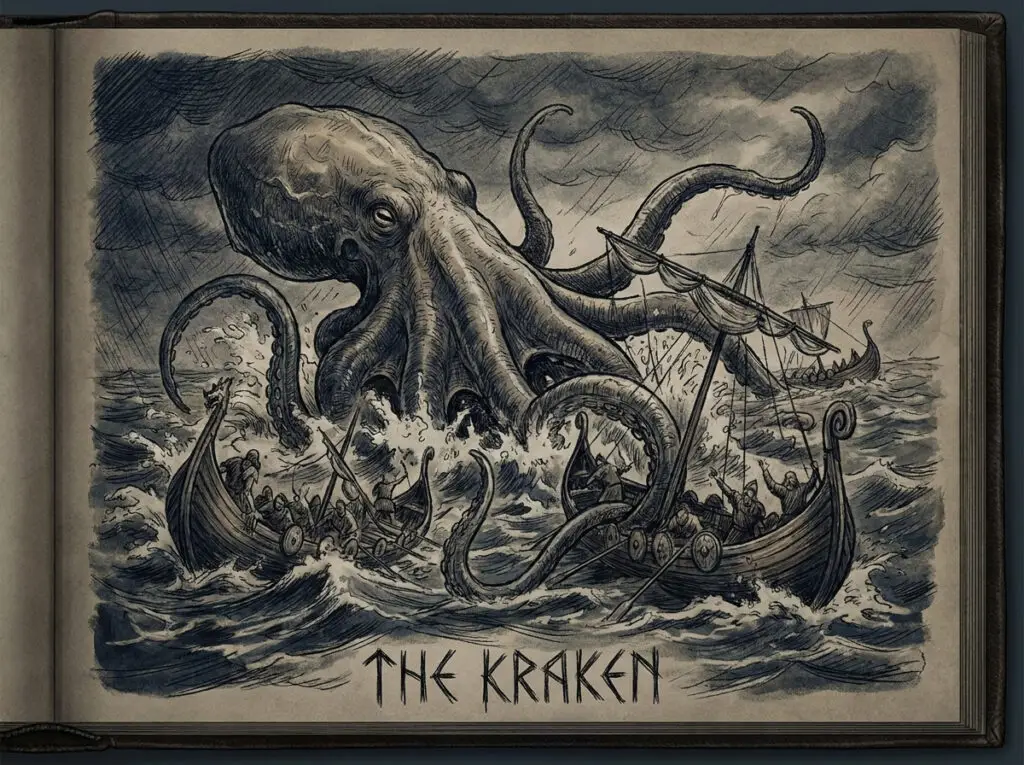
Table of contents
- Definition / Overview
- Core Concepts
- How the Kraken Works: Folklore & Biology
- Types of Kraken Myths
- Frequently Asked Questions
Definition / Overview
The kraken is a legendary sea monster of enormous size, typically described as resembling a giant cephalopod, such as an octopus or squid, said to dwell off the coasts of Norway and Scandinavia. The kraken is not a single, scientifically validated species, nor is it merely a fictional invention; it sits at the intersection of folk myth, sailors’ tales, and misunderstood marine biology.
What the kraken is: An enduring symbol of maritime folklore, a subject of mythological and scientific speculation, and an iconic figure in modern pop culture.
What the kraken is not: A proven biological animal, nor exclusively a creation of fantasy literature.
Why does it matter? The kraken represents humanity’s fascination with the unknown depths, our fears of the ocean, and the ways that myth and science can intertwine. Studying the kraken provides insight into how legends form, evolve, and influence culture, science, and art.
Brief History:
- First described in Scandinavian folklore from the 17th century, the kraken was believed to capsize ships and devour sailors.
- The legend likely arose from sightings of giant squid and octopus, with references in Greek, Norse, and later European literature.
- The kraken continues to influence modern media, science, and even taxonomy, with references ranging from literature to planetary geology.
Unlike many mythological creatures that carry moral or spiritual weight, dragons guarding treasure, gods dispensing justice , the Kraken is something rarer and more primal: a force of nature. It doesn’t hate humans. It simply exists, in impossible scale, at the borderline between the known world and the depths that swallow light.
The Etymology of “Kraken” : A Name Born from the Deep
The word *kraken* derives from the Norwegian *krake* (definite form: *kraken*), rooted in the Old Norse *kraki*, meaning something crooked, malformed, or gnarled, related to the Old Norse *krókr*, “hook.” The name was likely a figurative reference to the creature’s tentacles, which resembled the branchy, crooked tree-trunks used as primitive anchors (*kraker*) by Scandinavian fishermen.
The name captures something essential: the Kraken is not sleek or serpentine. It is ungainly, massive, and *wrong* in the way that only something too large for the surface world can be. It belongs in the crooked dark.
Core Concepts
What is Maritime Folklore?
Maritime folklore encompasses legends, myths, and stories told by sailors, fishermen, and coastal communities. The kraken is a classic example, emerging from tales of mysterious creatures in the deep ocean. These stories often blend observation, imagination, and superstition.
Example: Sailors encountering large, unfamiliar sea creatures might describe them as monstrous beings, giving rise to legends like the kraken.
Cephalopods: The Biological Inspiration
Cephalopods, octopuses, squids, and cuttlefish, are highly intelligent marine animals with flexible bodies and tentacles. Giant squid (Architeuthis dux) and colossal squid are often cited as real-world inspirations for kraken legends.
Why it matters: Giant cephalopods are rarely seen alive, fueling mystery and exaggeration in folklore. Their physical traits, size, tentacles, ink clouds, match many kraken descriptions.
Scandinavian Mythology and the Kraken
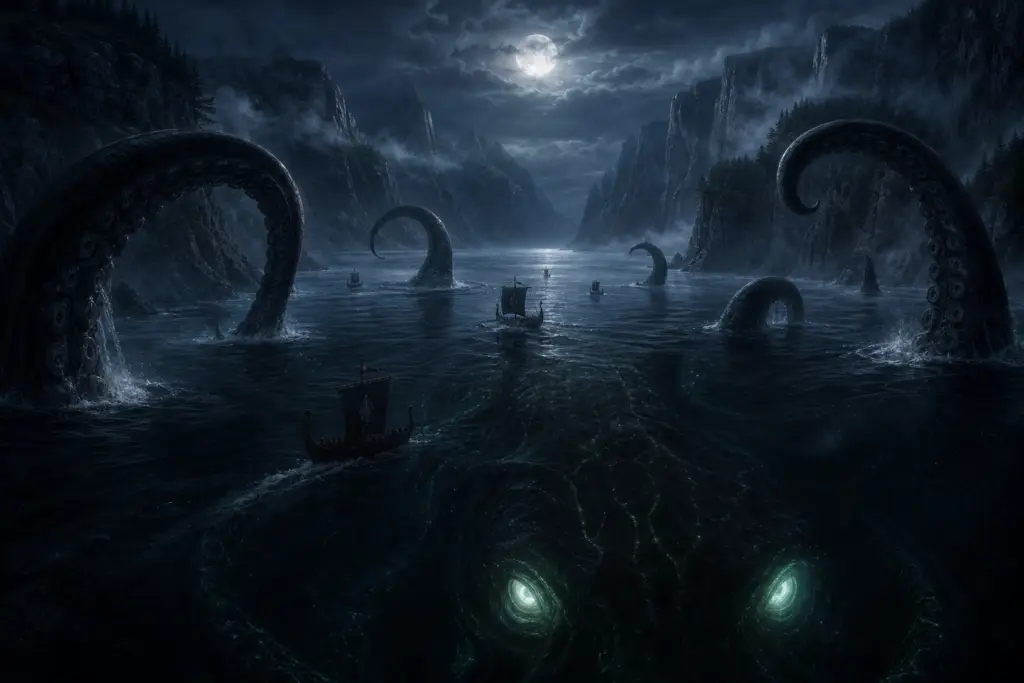
In Norse and Scandinavian mythology, the kraken is depicted as a monstrous sea beast capable of destroying ships. Early texts describe it as having many arms, sometimes mistaken for small islands.
Common misconception: Some believe the kraken is a uniquely Norwegian myth; however, tentacled sea monsters appear in Greek, Caribbean, Japanese, and Polynesian traditions.
Myth-Making: From Observation to Legend
Myths often begin with a kernel of truth, such as a sighting of a giant squid, then expand through retelling and imagination. Washed-up remains, unfamiliar animal behavior, and the isolation of sailors all contribute to the creation of legends.
Integration: The kraken myth incorporates biological observation, religious symbolism, and cultural fear, creating a complex, enduring narrative.
The Kraken in Modern Culture
The kraken appears in literature (Jules Verne, Tennyson), film (“Clash of the Titans”), video games (“Sea of Thieves”), and even as the name of an NHL team (Seattle Kraken). Its imagery continues to evolve, symbolizing both terror and awe.
Norwegian film *Kraken* (2026), dir. Pål Øie, theatrical + VOD release June 12, 2026. Multiple trailers circulating widely across film and horror communities.
Natural History Museum London’s *Jurassic Oceans: Monsters of the Deep* exhibition opened May 22, 2026, driving sea monster search interest.
How the Kraken Works: Folklore & Biology
Step-by-Step: Myth Formation
- Observation: Sailors spot an unfamiliar, large creature (e.g., giant squid).
- Interpretation: The sighting is shared and embellished, “It had tentacles as long as a ship!”
- Myth Creation: The creature is named (kraken), described as supernatural, and its behaviors exaggerated (e.g., sinking ships).
- Transmission: The story spreads, adapted by different cultures and artists.
- Scientific Inquiry: Naturalists investigate, sometimes identifying real animals behind the myth.
Analogy: The kraken serves as the ocean’s “ghost story,” blending fact and fiction to explain the unexplained.
Biological Candidates
For centuries, the Kraken was considered pure sailors’ fantasy. Then, in the 19th century, science began pulling something extraordinary out of the deep.
Giant Squid — The Real Monster Beneath the Myth
The classification of the giant squid (*Architeuthis dux*) by Western science in 1857, and the discovery of physical specimens in the following decades, transformed the Kraken from legend to plausible natural history. Female giant squid can reach up to 13 metres in length. Their eyes — the largest of any living animal — can measure up to 28 centimetres in diameter, roughly the size of a dinner plate. They hunt in the deep ocean, are rarely seen alive at the surface, and when they do surface, it is typically in a state of distress.
The Natural History Museum London, which opens its new *Jurassic Oceans: Monsters of the Deep* exhibition this month, holds “Archie”, an 8.62-metre giant squid specimen, the largest and most complete in the world. It is, by any measure, a Kraken in miniature.
As the NHM’s senior curator of mollusca Jon Ablett has noted: “What we think happened is that the partially digested or rotted remains of giant squid and large octopus were washing up on beaches and people were starting to guess what they might be. In Norway, the kraken myth grew and such washed-up specimens were interpreted as messages from God or the Devil.”
2026: When Palaeontology Found a Real-Life Kraken
In 2026, an international research team delivered the most extraordinary Kraken-adjacent scientific finding in decades. Studying 27 fossilised octopod jaws from outer-shelf deposits of Japan and Vancouver Island, they concluded that giant finned octopodes of the genus *Nanaimoteuthis* were highly intelligent apex predators — and possibly the largest animals in the Late Cretaceous seas, some 66–100 million years ago. Estimated at between 3 and 19 metres in length, *Nanaimoteuthis* fed on vertebrates with hard internal skeletons.
These were not mythological creatures. They were real. And they were, by any measure, Kraken-sized.
The discovery does not prove the medieval Kraken existed but it does prove something the legend always implied: that the ocean once held, and may still hold, cephalopod predators beyond the imagination of the surface world.
- Giant Squid: Live in deep waters; up to 13 meters; rarely seen; large eyes for detecting predators.
- Colossal Squid: Even larger; found in Antarctic waters; formidable tentacles.
- Starfish (Gorgonocephalus): Sometimes mistaken for kraken’s young in Norwegian lore.
Types of Kraken Myths
Scandinavian Kraken
- Aggressive, cephalopod-like, able to destroy ships.
- Best for maritime legends and cautionary tales.
Octopus-Inspired Kraken
- Depicted as enormous octopuses (French malacologist Pierre Denys de Montfort).
- Complexity: High; often conflated with squid.
Hafgufa (Icelandic)
- Whale-like, the largest sea monster; sometimes equated with the kraken.
- Pros: Extends kraken’s range to Greenland and Iceland.
The Kraken is Scandinavian in name, but the fear it represents is universal. Every major maritime culture developed its own version.
Akkorokamui, Japan’s Giant Cephalopod Spirit
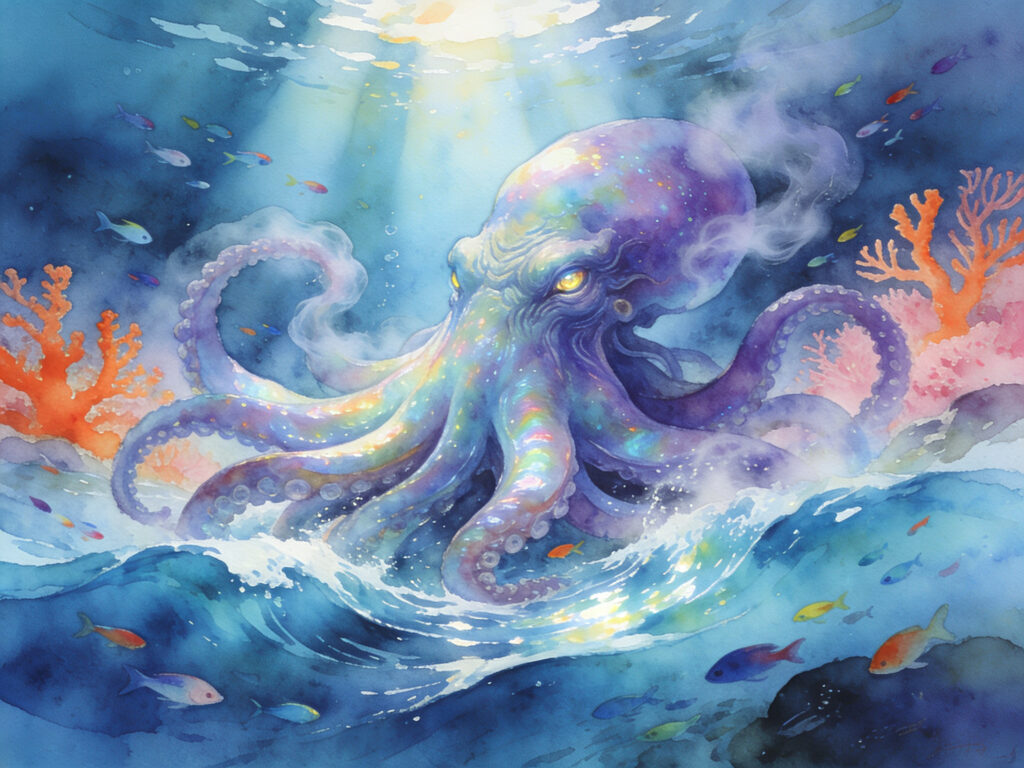
In the mythology of the Ainu people of Hokkaido, Japan, the **Akkorokamui** is a colossal octopus deity, blood-red in colour, said to haunt the waters of Funka Bay. Like the Kraken, it could destroy ships and drag sailors to their deaths. Unlike the Kraken, the Akkorokamui also has regenerative, healing properties in some traditions — a creature of destruction and restoration simultaneously. The parallel development of cephalopod monster mythology across Norse and Ainu cultures — two traditions with no known contact — is a striking example of what the Natural History Museum calls “convergent evolution in myth form.”
The Leviathan, Biblical Cousin of the Kraken
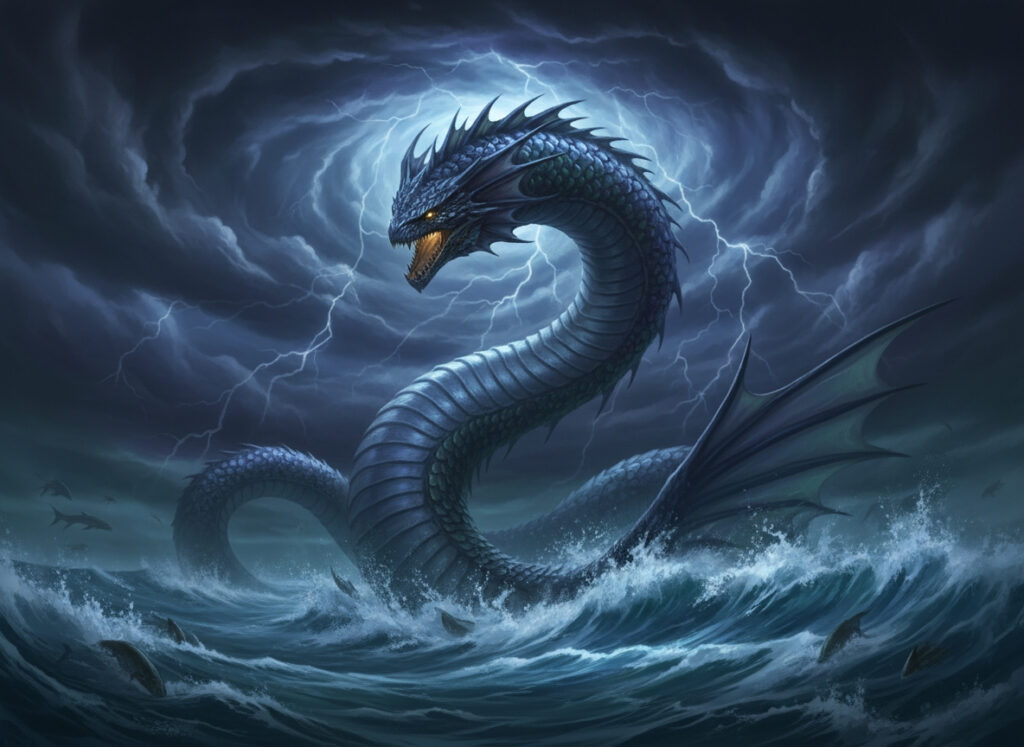
The **Leviathan** of the Hebrew Bible (*Job 41*, *Isaiah 27*) is perhaps the oldest documented sea monster in Western tradition: a chaos creature of the deep, described as breathing fire, with scales no sword can pierce, and eyes “like the eyelids of the morning.” Where the Kraken is physical and ecological — a creature of fjords and fishing grounds — the Leviathan is cosmic and theological, embodying the primordial chaos that precedes creation. Yet both serve the same cultural function: they mark the boundary between the ordered human world and the abyss beyond it.
Frequently Asked Questions
1. What is the difference between the kraken and Leviathan? Leviathan is often described as a sea serpent or dragon in biblical lore, while the kraken is a cephalopod-like monster of Scandinavian origin.
2. Is there scientific evidence for the kraken? No direct evidence exists, but sightings of giant squid and other large cephalopods inspired the myth.
3. How long does it take to study kraken myths? Research depends on depth; basic understanding can be gained in hours, but comprehensive analysis may take weeks.
4. Why isn’t the kraken considered a real animal? The kraken is based on folklore and exaggerated tales, not on confirmed species.
5. Are there real creatures similar to the kraken? Yes, giant squid and octopus share many traits with kraken descriptions.
6. Can the kraken integrate with modern science? Yes, through taxonomy, deep-sea exploration, and DNA analysis.
7. What is the Codex of the Beasts? It is a proprietary methodology and encyclopedia for investigating mythical creatures, including the kraken.
8. How do myths evolve over time? Through retelling, artistic adaptation, and integration with scientific discoveries.
9. What are the biggest misconceptions about the kraken? That it is a uniquely Norwegian myth or that it was proven to exist as described in folklore.
10. Can I see a kraken today? No, but you can view giant squid specimens in museums and kraken representations in art and media.
11. How does the kraken compare to other mythical sea monsters? It shares traits with creatures like Hydra and Cthulhu, but is distinct in its cephalopod form.
12. Are kraken myths still relevant? Yes, they inform pop culture, science, and environmental awareness.