Last updated: July 4, 2026
Mythology is the collection of stories a culture tells about gods, heroes, supernatural beings, creation, nature, and human questions that feel bigger than ordinary daily life. For children, mythology is best explained not as a list of “false stories,” but as a body of meaningful traditional stories that helped people understand the world, teach values, and imagine forces beyond human control. According to Britannica Kids, myths tell of gods, heroes, and events that a group believes, or once believed, to be real; they are often closely tied to religion and cultural identity.
Mythology is not exactly the same as modern fantasy, even though both may contain dragons, magical objects, talking animals, or impossible journeys. Fantasy is usually invented by known authors for imaginative storytelling. Mythology, by contrast, emerges from communities over time and carries cultural memory, symbolism, ritual meaning, and moral questions. That distinction matters when adults introduce myths to children: the goal is not merely entertainment, but understanding how stories shape civilizations.
For parents, teachers, librarians, and content creators, explaining mythology to children requires a careful balance of accuracy, emotional sensitivity, and age-appropriate framing. Some myths contain violence, transformation, jealousy, betrayal, or difficult family dynamics. Yet mythology also offers powerful learning opportunities in language, history, symbolism, ethics, imagination, and comparative culture.
Table of contents
- What mythology means for children
- Core concepts and fundamentals
- How to explain mythology to children
- Types of mythology children can explore
- Best practices for adults
- Frequently asked questions
What Mythology Means for Children
When mythology is explained well, children usually understand it as a special kind of story: old, memorable, imaginative, and important to the people who told it. The educational aim is not to pressure children into belief or disbelief. Instead, it is to help them see that myths answered real questions for earlier societies:
- Why does the sun move across the sky?
- Why do storms happen?
- Why do people suffer?
- What makes a good ruler or a brave hero?
- Why do some creatures symbolize wisdom, danger, or rebirth?
Children often respond well when mythology is introduced as a meaning-making system. A myth may explain a natural event, preserve a value, honor an ancestor, or dramatize fears and hopes. For example, a phoenix can symbolize renewal; a dragon may symbolize chaos, treasure, danger, kingship, or protection depending on the culture.
This broad definition also makes mythology easier to connect with the atmosphere of Mythical Creatures DNA, where creatures are treated as traces of cultural memory rather than simple monsters. On a site that explores dragons, hydras, unicorns, griffins, kitsune, and ravens, mythology can be presented as a map of how humans imagined the unknown.
Core Concepts and Fundamentals
1. Myth is a cultural story, not just a magical story
Children often assume that if a story includes magic, it must be a myth. That is understandable, but incomplete. A myth is usually tied to a culture, a worldview, or a religious imagination. Its importance comes from the meaning it carried within a community.
A useful explanation is: “A myth is an old traditional story that helped people explain the world, remember their beliefs, and share what mattered to them.” This wording avoids dismissiveness while remaining accurate.
Why it matters: Children learn that stories can preserve knowledge, not just entertain.
Example: Zeus is not simply a character with lightning powers; in Greek myth, he is part of a larger explanation of order, kingship, storms, and divine authority.
2. Mythology and religion may overlap
Many children ask whether myths are “real religions” or “made-up stories.” A balanced answer is that mythology often overlaps with religion, especially in ancient cultures. Some stories were sacred to the people who told them.
Adults should therefore avoid mocking or flattening these traditions. A respectful phrase works well: “These stories were meaningful and sometimes sacred in the cultures that told them.”
Why it matters: This teaches cultural respect and prevents mythology from becoming a caricature.
3. Mythology uses symbols
A symbol is something that stands for a larger idea. Children can grasp symbolism surprisingly early when concrete examples are used. An owl may symbolize wisdom; a wolf may symbolize danger, loyalty, wilderness, or transformation; a river may symbolize passage between worlds.
Symbolism helps children understand why creatures recur across myths. A hydra is not only a many-headed beast; it also represents a problem that grows when handled badly. That makes mythology relevant to emotional and moral development.
Example: If one head is cut and two return, children can connect the image to real-life problems such as rumors, anger, or fear becoming larger when fed.
4. Myths answer big questions
Many myths begin where scientific explanation did not yet exist or where existential questions remained unresolved. Creation myths, flood myths, underworld journeys, and tales of transformation all try to answer questions about beginnings, endings, and the forces shaping human life.
The Mensa for Kids educational material on Greek mythology highlights this by using creation stories as a framework before introducing gods and heroes. That teaching sequence is effective for children because it starts with the broadest question: How did the world begin?
Why it matters: Children learn that mythology is intellectually serious, even when imaginative.
5. Different cultures have different mythic systems
A common misconception is that mythology means only Greek mythology. In reality, mythology is global. Norse, Egyptian, Mesopotamian, Celtic, Japanese, West African, Indigenous American, Hindu, and many other traditions contain rich mythic systems.
Presenting multiple traditions prevents the subject from becoming narrow or Eurocentric. It also helps children notice patterns, creation, tricksters, monsters, sky gods, heroic quests, without assuming all stories mean the same thing.
6. Mythological creatures are part of broader story worlds
Children are often introduced to mythology through creatures first. That is effective, but adults should connect each creature to its surrounding narrative world.
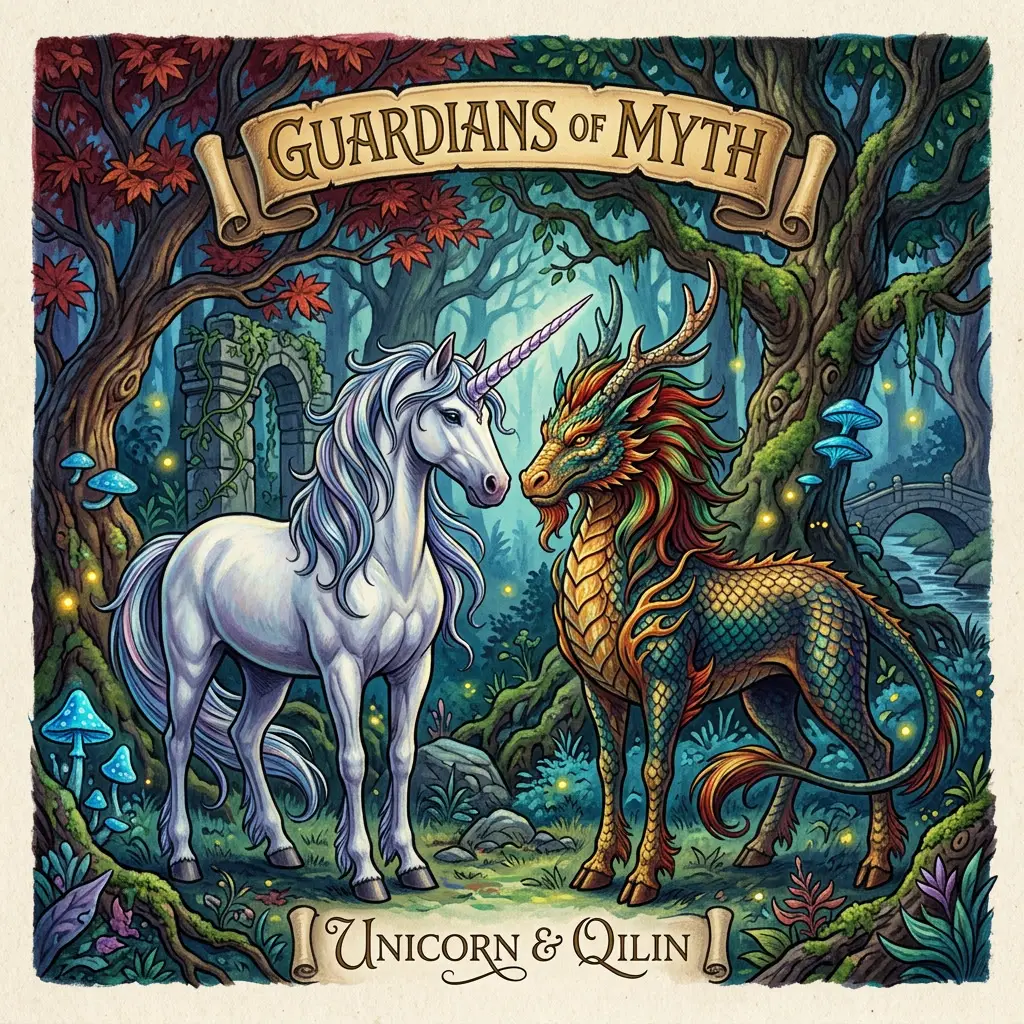
A griffin is more than an eagle-lion hybrid. A unicorn is more than a horse with a horn. A phoenix is more than a fire bird. Each creature carries symbolic and historical meanings shaped by art, religion, trade, folklore, and literature.
Why it matters: Context transforms creature facts into real cultural learning.
How to Explain Mythology to Children
The most reliable method is progressive: begin with simple definitions, then move from familiar creatures and stories toward larger cultural ideas.
Step 1: Start with a child-friendly definition
Use one or two sentences first.
Suggested definition:
Mythology is a group of old stories that people told to explain the world, teach lessons, and remember what their culture believed.
If the child is very young, simplify further:
Myths are old important stories about gods, heroes, magical beings, and big questions.
Step 2: Explain what myths do
Children understand function better than abstract categories. Ask:
- Does the story explain nature?
- Does it teach a lesson?
- Does it tell us what people admired or feared?
- Does it introduce a god, hero, or creature important to a culture?
This shifts the conversation from “Is it true?” to “What is this story trying to mean?”
Step 3: Use examples from creatures children already recognize
Begin with high-interest figures:
- Dragons
- Phoenix
- Pegasus
- Unicorns
- Werewolves
- Harpies
- Kitsune
These are concrete entry points. Once interest is established, adults can add context:
- Where does this creature appear?
- What does it symbolize?
- Is it feared, admired, or both?
- How does one culture’s version differ from another’s?
Step 4: Separate mythology from modern fantasy without devaluing either
A useful comparison for children:
| Feature | Mythology | Modern Fantasy |
|---|---|---|
| Origin | Grows from tradition and culture | Usually created by an author |
| Purpose | Meaning, ritual, identity, explanation | Entertainment, world-building, theme |
| Characters | Gods, heroes, sacred beings, symbolic creatures | Invented characters in fictional settings |
| Example question | “What did people believe this creature meant?” | “What role does this creature play in the story?” |
This helps children avoid the idea that mythology is merely “old fantasy.”
Step 5: Adapt by age and emotional readiness
Ages matter. Not every myth suits every child.
| Age Range | Good Approach | Avoid or Limit |
|---|---|---|
| 4–6 | Short retellings, creature focus, simple morals | Graphic violence, complex family conflict |
| 7–9 | Introductory myths, hero journeys, creation stories | Disturbing punishments without context |
| 10–12 | Symbolism, comparison across cultures, nuanced discussion | Overloading with genealogy and dense names |
| 13+ | Original sources, interpretation, ethics, historical context | Oversimplifying difficult themes |
Step 6: Tell the story, then discuss the meaning
Story first, analysis second. Children need narrative before interpretation.
A simple teaching pattern:
- Tell or read the myth.
- Ask what happened.
- Ask how the characters felt.
- Ask what the story explains.
- Ask what symbol or lesson stands out.
This method mirrors strong literacy instruction and makes mythology less abstract.
Step 7: Invite comparison
After one story, add another from a different culture or with a different creature. Comparison is one of the strongest educational tools.
Examples:
- Dragon as destroyer vs dragon as guardian
- Bird as omen vs bird as rebirth symbol
- Trickster as troublemaker vs trickster as teacher
Step 8: Encourage creative response
Children remember mythology better when they draw, map, dramatize, or invent. The Mensa for Kids lesson approach includes having learners create a god/goddess or a myth explaining a natural phenomenon. That is pedagogically strong because creation reveals understanding.
Possible activities:
- Draw a creature and label its symbolic features
- Make a “myth map” of a world
- Invent a myth about thunder, rivers, seasons, or stars
- Compare two mythological animals in a notebook
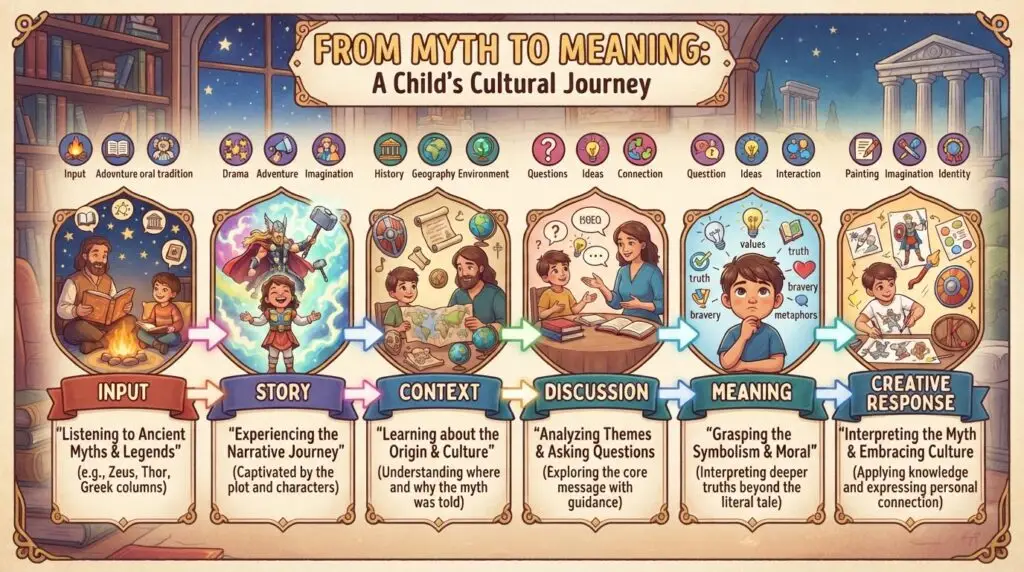
Process Flow
Input → Story → Context → Discussion → Meaning → Creative Response
Types of Mythology Children Can Explore
Introducing categories helps adults build a curriculum rather than choosing stories at random.
Types of Mythology Children Can Explore
1. Creation myths
These explain how the world, gods, people, animals, or landforms began. They are excellent starting points because children naturally ask origin questions.
Best for: Ages 7+ with guided discussion
Strengths: Big-picture thinking, cultural worldview, memorable imagery
Challenge: Some creation stories are complex or theologically sensitive
2. Hero myths
Hero myths follow a brave or flawed character through trials, monsters, journeys, loss, and return. They often resonate strongly with children because they contain action and clear stakes.
Best for: Ages 6+ depending on adaptation
Strengths: Courage, choices, consequences, identity
Challenge: Can include violence that needs careful retelling
3. Creature myths
These center on dragons, unicorns, griffins, hydras, harpies, werewolves, or other beings. They are often the best entry point for young readers because the imagery is immediate.
Best for: Nearly all ages with adaptation
Strengths: High engagement, visual learning, symbolism
Challenge: Adults may focus only on appearance and miss cultural meaning
4. Trickster myths
Trickster stories feature clever, disruptive, or rule-bending figures. These myths help children think about intelligence, mischief, fairness, and unintended consequences.
Best for: Ages 8+
Strengths: Humor, ethical discussion, ambiguity
Challenge: Requires discussion so children do not confuse explanation with endorsement
5. Nature and seasonal myths
These explain weather, harvest, winter, spring, floods, droughts, stars, or animal behavior. They connect mythology to observation and early science history.
Best for: Ages 5+
Strengths: Cross-curricular links to science and geography
Challenge: Needs clear distinction between symbolic explanation and scientific explanation
6. Underworld and transformation myths
These deal with death, loss, rebirth, curses, shape-shifting, or spiritual boundaries. They are powerful but require maturity.
Best for: Older children and teens
Strengths: Emotional depth, symbolism, moral complexity
Challenge: Potentially frightening or confusing without guidance
Comparison Table
| Type | Best For | Complexity | Emotional Intensity |
|---|---|---|---|
| Creation myths | Big questions | Medium | Medium |
| Hero myths | Adventure learners | Medium | Medium-High |
| Creature myths | Beginners | Low-Medium | Low-Medium |
| Trickster myths | Discussion-based learning | Medium | Low-Medium |
| Nature myths | Cross-curricular study | Low-Medium | Low |
| Underworld/transformation myths | Older learners | High | High |
Best Practices for Adults
1. Start with respect, not debunking
Do not begin by saying myths are “just fake stories.” That framing reduces cultural complexity and discourages curiosity. A better opening is: “These are traditional stories that mattered deeply to the people who told them.”
Common mistake: Turning mythology into either mockery or rigid fact-checking.
2. Choose age-appropriate versions
Many original myths contain mature content. Use adapted retellings for younger children while keeping the central meaning intact.
How to implement: Read ahead and identify scenes involving violence, coercion, revenge, or disturbing imagery.
3. Explain difficult material honestly but gently
If a child encounters conflict or cruelty in a myth, do not panic or overexplain. Brief context works: “Some old stories include harsh events because they were trying to show fear, power, or danger.”
Why it works: Children often need framing more than censorship.
4. Focus on one big idea per session
A single reading session does not need to cover plot, symbolism, cultural history, vocabulary, art history, and comparative religion at once. Choose one anchor concept.
Possible anchors:
- bravery
- transformation
- pride
- seasons
- monsters and fear
- wisdom
5. Use concrete comparisons
Children understand abstract ideas through familiar contrasts.
Examples:
- Mythology is to culture what family stories are to a household.
- A symbol is like a sign that carries more than one meaning.
- A creature can stand for an idea, not only an animal.
6. Ask open-ended questions
Good mythology teaching is dialogic, not lecture-only.
Useful prompts:
- Why do you think people told this story?
- What feeling does this creature represent?
- What part seems symbolic rather than literal?
- What does this myth say about courage or danger?
7. Connect myths to art, places, and language
Mythology appears in paintings, constellations, architecture, idioms, and literature. Children retain more when they see myths across media.
Example: Owls on your site can connect to wisdom symbolism in multiple traditions; wolves can connect to wilderness, loyalty, fear, or transformation.
8. Compare without flattening
It is helpful to compare a phoenix and a dragon or Greek and Norse traditions, but avoid suggesting that all cultures “basically believed the same thing.” Similar patterns exist, but meanings differ.
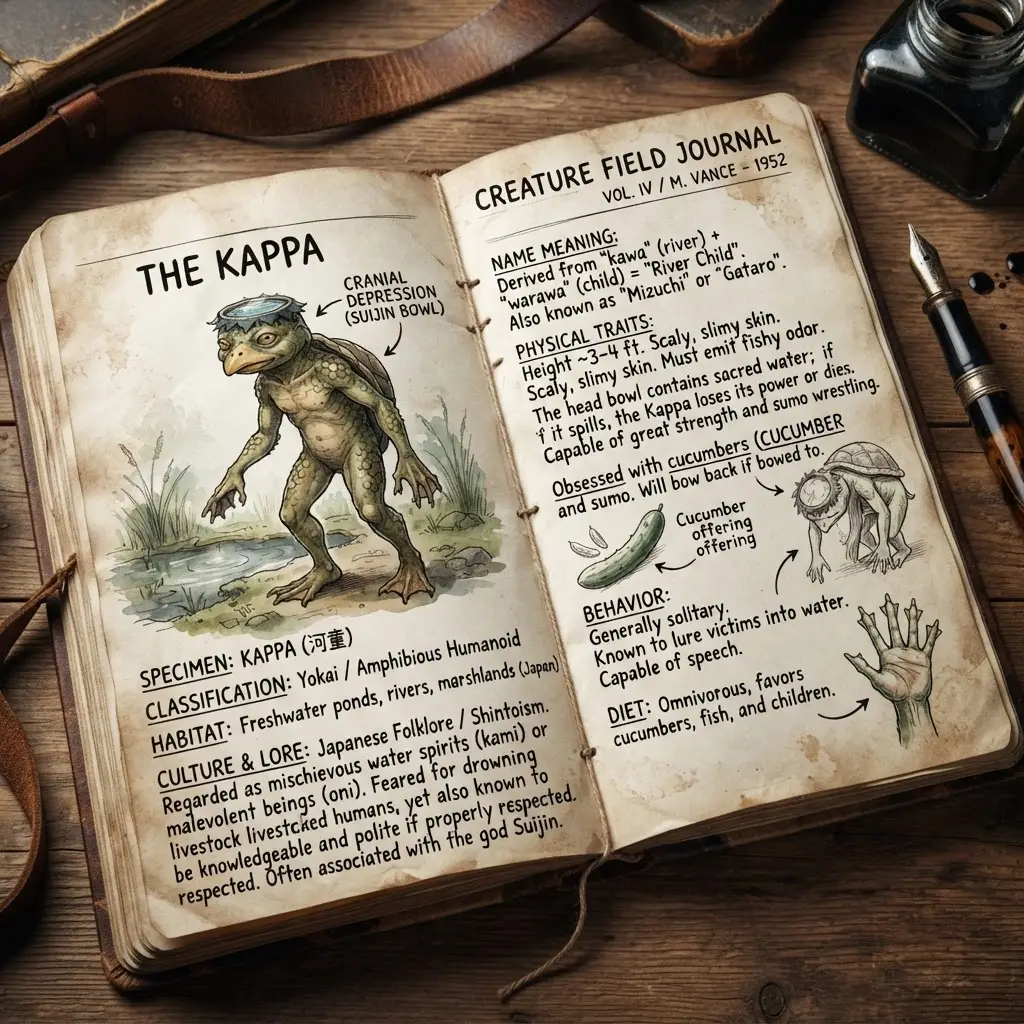
9. Encourage note-taking like a young researcher
A field-journal approach fits the customer site especially well. Children can make entries for:
- Creature name
- Culture or region
- Story role
- Symbolic meaning
- Emotion associated with it
- Questions still unanswered
10. Revisit favorite myths over time
Children understand the same myth differently at ages 6, 9, and 13. Repetition builds depth.
Common mistake: Treating mythology as a one-time novelty topic.
Frequently Asked Questions
What is the simplest way to explain mythology to a child?
Say that mythology is a collection of old important stories about gods, heroes, creatures, and big questions. Then give one concrete example, such as a dragon story or a creation myth.
Is mythology the same as fantasy?
No. Mythology comes from cultural tradition and often carried sacred or social meaning. Fantasy is usually created by an author as imaginative fiction.
At what age can children start learning mythology?
Many children can begin around ages 4–6 with gentle creature stories and simple explanations. More complex myths usually work better from ages 7 and up, depending on the child.
Should adults tell children that myths are true or false?
A balanced approach is best. Explain that these were meaningful traditional stories that people used to explain the world and express beliefs, values, and fears.
Why do so many myths contain monsters?
Monsters often represent danger, chaos, fear, the unknown, or moral tests. They make invisible worries visible and memorable.
How do I handle violent or frightening myths?
Use age-appropriate retellings, summarize rather than dramatize disturbing details, and discuss what the story is trying to communicate. Children need context and reassurance.
Why are mythological creatures so useful for teaching?
Creatures create immediate visual interest and help children remember symbolic meanings. They also serve as bridges into broader cultural and historical discussions.
Is Greek mythology the best place to start?
It is a common starting point because many accessible resources exist, but it should not be the only one. Children benefit from seeing mythology as a global human practice.
Can mythology support school learning?
Yes. It strengthens reading comprehension, vocabulary, cultural literacy, symbolism, writing, art response, and comparative thinking.
How long does it take for children to understand mythology well?
Understanding grows over time. A child may grasp the story quickly, but deeper understanding of symbolism and cultural context usually develops through repeated exposure.