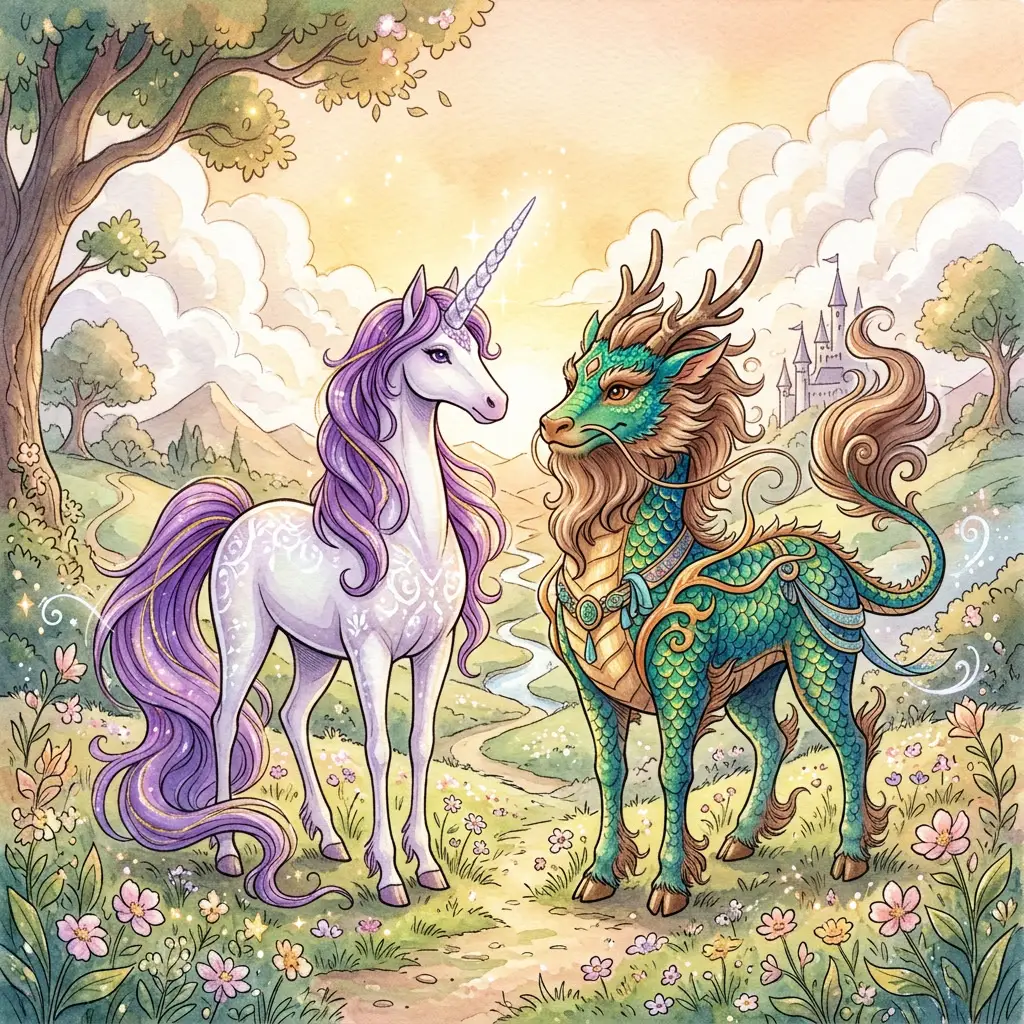
Unicorns in medieval European folklore and the Qilin of ancient Chinese mythology are both legendary creatures associated with rarity, moral meaning, and cultural ideals, but they are not the same being in different costumes. The medieval unicorn is usually imagined as a single-horned, horse-like woodland creature tied to purity, chastity, and spiritual allegory. The Qilin, by contrast, is an auspicious East Asian mythic beast linked to benevolent rule, prosperity, cosmic harmony, and the appearance of sages.
Although modern popular culture sometimes flattens both creatures into the vague idea of a “magical horned animal,” traditional sources give them distinct forms, temperaments, and symbolic roles. The unicorn belongs largely to a European symbolic world shaped by bestiaries, Christian interpretation, courtly literature, and heraldic imagination. The Qilin belongs to a Chinese mythological and philosophical world shaped by classical texts, omen lore, rulership ethics, and auspicious cosmology.
For readers studying comparative mythology, these creatures offer an excellent case study in how different civilizations assign moral meaning to fantastic animals. One creature becomes a sign of untouched purity and spiritual truth; the other becomes a sign of righteous governance, future greatness, and heavenly favor.
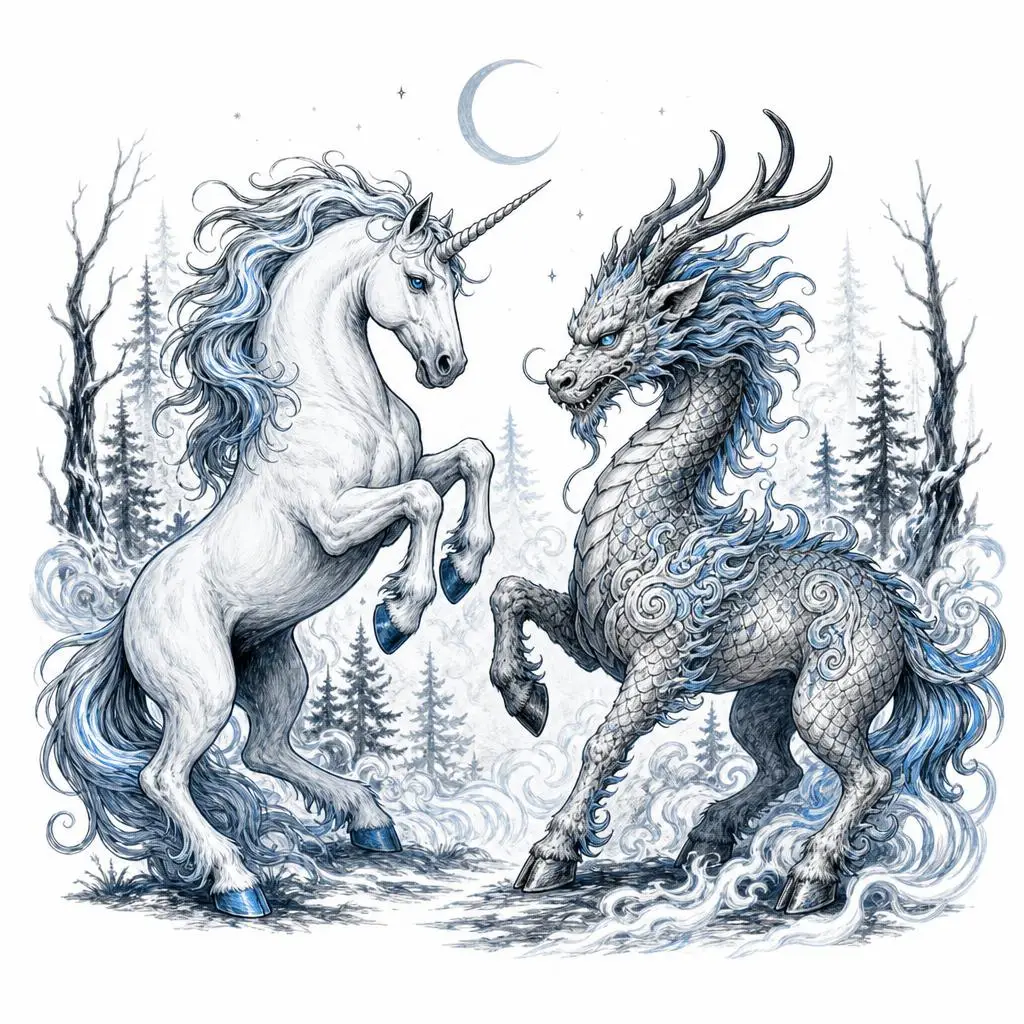
Table of Contents
Overview: The Short Answer
Core Concepts
How These Creatures Function in Myth
Types of Depiction
Direct Comparison Table
Best Practices for Interpreting Mythic Creatures
Advanced Considerations
Tools and Resources
Frequently Asked Questions
Overview: The Short Answer
In their respective cultures, the medieval European unicorn represents purity, spiritual innocence, chastity, and rare truth, while the ancient Chinese Qilin represents benevolence, righteous rule, prosperity, and the arrival or presence of extraordinary virtue.
The primary differences can be summarized simply:
- Appearance: Unicorns are typically horse-like with one spiraled horn; Qilin are composite creatures, often deer-like or equine but with scales, cloven hooves, a dragon-like head, and one or sometimes two horns.
- Temperament: Unicorns are often wild, elusive, and difficult to approach; Qilin are gentle, restrained, and intentionally nonviolent.
- Symbolism: Unicorns often symbolize purity and spiritual allegory; Qilin symbolize auspicious governance, moral order, and heavenly blessing.
Core Concepts
What the Medieval European Unicorn Is
The medieval European unicorn is a legendary beast described in bestiaries, romances, and religious allegories as a rare animal with a single horn. In visual tradition, it is commonly shown as white, horse-like, and elegant, though older descriptions sometimes give it deer-like feet, a goat’s beard, or other hybrid traits.
What matters most in medieval Europe is not zoological consistency but symbolic function. The unicorn becomes an emblem of purity, grace, and untamed spiritual value. In some texts it is so wild that no hunter can capture it by force. Instead, it is calmed only in the presence of a virgin, a motif that medieval Christian writers interpreted allegorically.
This symbolism made the unicorn useful in courtly, religious, and artistic settings. It could mean innocence, ideal beauty, noble restraint, or divine mystery depending on context.
What the Qilin Is
The Qilin is a revered mythical creature in Chinese tradition, often called the “Chinese unicorn” in modern English, though that label can be misleading if treated too literally. Traditional descriptions vary, but the Qilin is usually a composite being whose body recalls a deer, horse, ox, or dragon, often with scales and a radiant or flame-like aura.
Unlike the European unicorn, the Qilin is not mainly a symbol of virginity or personal purity. Its significance is broader and more civic. It is an auspicious omen, associated with benevolent government, peace, prosperity, and the arrival of a sage or virtuous ruler.
Classical and later traditions connect the Qilin with moral order. It appears rarely, and when it appears, its presence suggests that heaven recognizes exceptional virtue on earth.
Why Their Horns Do Not Mean the Same Thing
A common misconception is that the horn defines the entire meaning of both creatures. In fact, the horn is only one element. For the unicorn, the single horn becomes central to visual identity and later folklore about healing, antidotes, and the precious alicorn. For the Qilin, the horn may be present, but it does not monopolize the creature’s symbolic meaning.
Some descriptions of the Qilin mention one horn, others two horns. This alone shows why equating it too closely with the European unicorn is reductive. The Qilin’s significance lies less in singular anatomy and more in moral and cosmic function.
Purity in Europe vs Auspicious Virtue in China
Both creatures can be called “pure,” but the word operates differently in each tradition. In medieval Europe, purity often carries a strongly moralized and spiritual dimension tied to innocence, chastity, and Christian symbolism. The unicorn’s purity is intimate, personal, and allegorical.
In Chinese tradition, the Qilin’s purity is better understood as benevolent harmlessness and auspicious virtue. It is said not to injure living things needlessly and not to tread carelessly upon life. Its goodness is ethical and cosmic rather than narrowly ascetic.
Wilderness vs Moral Order
The unicorn often belongs to the forest, the chase, and the threshold between civilization and the untamed world. It is elusive and difficult to seize. That wildness is part of its meaning: purity cannot be possessed casually.
The Qilin, by contrast, is not usually framed as prey or quarry. It appears as a sign within a moral universe. Its role is closer to revelation than pursuit. Where the unicorn is often encountered through hunting imagery, the Qilin is encountered through omen literature and accounts of extraordinary times.
Christian Allegory vs Confucian-Auspicious Interpretation
The unicorn’s medieval meaning was shaped heavily by allegorical reading. In bestiary tradition, the animal could symbolize Christ, the Incarnation, or the triumph of spiritual truth clothed in animal narrative.
The Qilin’s interpretive world is different. It is closely tied to classical Chinese ideas about just rule, sagehood, and heaven’s moral order. Traditions linking the Qilin to Confucius reinforce its role as a sign of extraordinary wisdom and historical significance.
How These Creatures Function in Myth
Step 1: A culture imagines a rare creature
Both traditions begin with a creature that is extraordinary, seldom seen, and difficult to classify within ordinary nature. Rarity gives the being authority.
Step 2: The creature is assigned ethical meaning
The creature is not just strange; it becomes morally legible.
- In Europe: rarity + beauty + untamable nature = purity and spiritual allegory.
- In China: rarity + gentleness + auspicious appearance = virtue, righteous leadership, and cosmic approval.
Step 3: Art and literature stabilize the image
Over time, manuscripts, paintings, textiles, sculpture, and storytelling repeat recognizable traits. The unicorn becomes increasingly horse-like in many later European depictions. The Qilin remains more variable in appearance but stable in symbolic value.
Step 4: The creature becomes a cultural shorthand
Eventually, each beast stands for larger ideas:
- Unicorn → innocence, chastity, grace, spiritual truth, noble rarity
- Qilin → benevolence, wise rule, prosperity, sagehood, auspicious destiny
Step 5: Later readers simplify what older traditions kept complex
Modern readers often reduce both creatures to decorative fantasy animals. Comparative mythology corrects that simplification by restoring context, text tradition, and cultural logic.
Types of Depiction
Bestiary Unicorn
This is the learned medieval unicorn found in moralized animal books. It is less a fantasy pet than an encoded lesson. Its behavior is described in a way that invites allegorical interpretation.
Best for understanding: medieval Christian symbolism and manuscript culture.
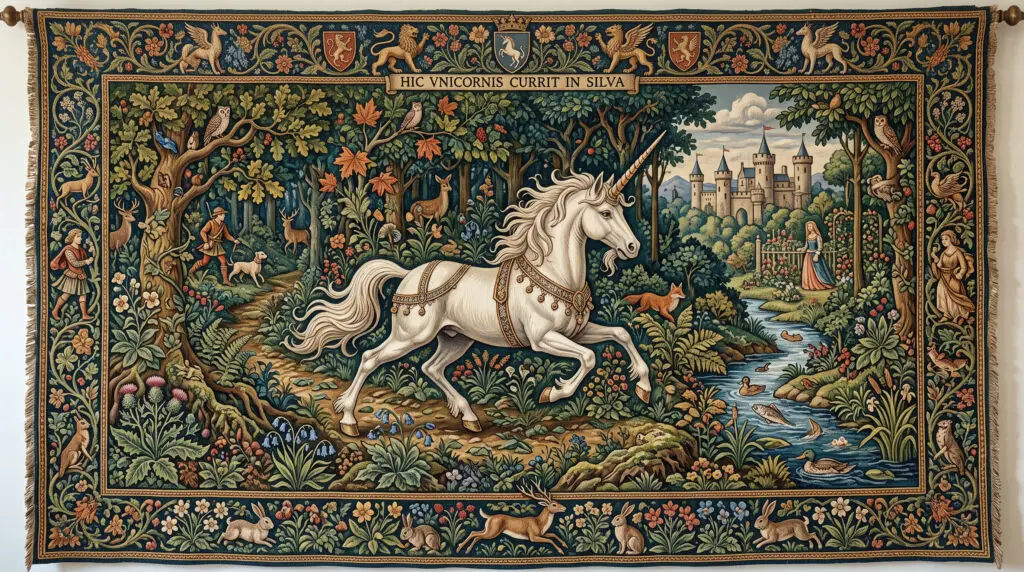
Courtly or Heraldic Unicorn
This version emphasizes nobility, elegance, and prestige. In heraldry, the unicorn can represent strength under discipline, high lineage, and idealized virtue.
Best for understanding: political and aristocratic uses of myth.
Classical Qilin
This form appears in early texts and omen traditions as an auspicious creature associated with sage-kings, social harmony, and righteous times.
Best for understanding: Chinese classical thought and symbolic kingship.

Artistic or Decorative Qilin
This version appears in textiles, architecture, ceramics, badges, and regional visual traditions. Its body may become more ornate or dragon-like while retaining auspicious associations.
Best for understanding: how mythic symbols travel through art and dynasty.
Comparative Hybrid Readings
Modern discussions sometimes force the Qilin into a Western “unicorn” category because both may have horns and purity associations. This can be a helpful starting point, but it should not replace the creature’s own cultural identity.
Best for understanding: translation limits and cross-cultural comparison.
Direct Comparison Table
| Feature | Medieval European Unicorn | Ancient Chinese Qilin |
|---|---|---|
| Cultural sphere | Medieval and Renaissance Europe | Ancient and imperial China, later East Asia |
| Usual body form | Horse-like, often white; sometimes goat/deer features | Composite form: deer, horse, ox, dragon-like traits, scales |
| Horns | Usually one spiraled horn | One or sometimes two horns |
| Temperament | Wild, elusive, difficult to capture | Gentle, benevolent, restrained, nonviolent |
| Habitat in imagination | Forests, wilderness, courtly tapestries, allegorical scenes | Auspicious appearances, sacred narrative, court and literary symbolism |
| Main symbolic meaning | Purity, chastity, grace, spiritual truth | Prosperity, righteous rule, virtue, sagehood, good fortune |
| Religious-philosophical frame | Bestiaries, Christian allegory, courtly symbolism | Classical texts, omen lore, Confucian moral order |
| Relationship to humans | Avoids capture except in symbolic circumstances | Appears as a sign rather than an object of pursuit |
| Violence | Can be fierce when threatened, but mainly framed as untamable | Noted for refusing to harm living things unnecessarily |
| Social function | Moral allegory and noble emblem | Auspicious sign of just governance and future greatness |
Best Practices for Interpreting Mythic Creatures
1. Compare meanings, not just shapes
Two creatures may both have horns and still mean very different things. Interpretation should begin with cultural function rather than silhouette.
2. Distinguish text tradition from modern fantasy
The medieval unicorn is not identical to the pastel pop-culture unicorn, and the Qilin is not simply a Chinese variant of that same figure. Use historical sources wherever possible.
3. Watch for translation shortcuts
Calling the Qilin a “Chinese unicorn” may help beginners, but it can also erase important differences. Treat it as an entry point, not a final definition.
4. Read symbolism within local belief systems
European purity language emerges from one moral-theological framework; Chinese auspiciousness emerges from another. Similar words can hide different values.
5. Notice how temperament shapes symbolism
The unicorn’s elusiveness supports its symbolism. The Qilin’s gentleness supports its symbolism. Behavior matters as much as anatomy.
6. Use visual evidence carefully
Art varies across centuries. A single painting cannot define an entire tradition. Compare manuscripts, sculpture, textiles, and literature together.
7. Avoid assuming myth means uniformity
Neither creature has one fixed canonical appearance. Mythological beings often remain stable in meaning while flexible in image.
8. Connect creature lore to social ideals
The unicorn reflects ideals of purity and spiritual authority. The Qilin reflects ideals of moral government and harmonious order. Both are mirrors of what a culture esteems.
Advanced Considerations
Symbolic Ecology
The unicorn and Qilin belong to different symbolic ecologies. The unicorn often interacts with hunters, virgins, forests, and theological interpretation. The Qilin interacts with rulers, sages, omens, and dynastic ethics. Each creature lives inside a network of meanings, not in isolation.
Composite Anatomy and Cultural Logic
Modern readers sometimes think a variable appearance indicates inconsistency or confusion. In myth, composite anatomy often signals elevated status. The Qilin’s mixed features communicate wonder, rarity, and cosmological importance. Likewise, even the unicorn’s apparent simplicity is shaped by centuries of symbolic filtering rather than biological precision.
Why the Qilin Is More Public and the Unicorn More Personal
The unicorn often embodies virtues imagined at the level of the soul, body, or courtly ideal. The Qilin more often signifies the condition of the realm: whether rule is just, whether heaven approves, whether greatness is near. This makes the Qilin symbolically more civic and state-facing.
Comparative Mythology as Cultural Reading
The most useful comparison is not “Which creature is stronger?” but “What cultural work does each creature perform?” On that level, both are moral indicators. Yet the unicorn marks purity in a spiritually charged, intimate register, while the Qilin marks harmony in a political-cosmic register.
Tools and Resources
Recommended Reading Paths on This Site
- Explore the Unicorn entry in the Codex of the Beasts for creature-specific lore.
- Read Dark Academia Mythology and Legendary Creatures – Complete Guide for the broader symbolic atmosphere of creature study.
- Use Understanding Mythology for Children: A Complete Guide as a beginner-friendly companion resource.
- Browse the Codex of the Beasts to compare related creatures such as dragons, phoenixes, and griffins.
- Visit The Journal for additional myth-analysis articles and lore notes.
Primary Source and Research Directions
- Medieval European bestiaries and religious allegory
- Heraldic traditions and tapestry studies
- Classical Chinese texts mentioning the lin/Qilin
- Scholarship on Confucian omen interpretation
- Art-historical studies of rank badges, ceramics, and sculpture
Practical Study Method
When comparing mythic beings, create a table with five columns: appearance, behavior, symbolic role, textual setting, and social function. This prevents shallow one-to-one comparisons.
Frequently Asked Questions
Is the Qilin just the Chinese version of a unicorn?
No. The label can be useful as a loose translation aid, but the Qilin has a distinct history, symbolic function, and visual tradition that cannot be reduced to the European unicorn.
What does the unicorn represent in medieval European folklore?
Most commonly, it represents purity, chastity, grace, and spiritual truth. In Christian allegorical reading, it can also carry theological meaning beyond simple folklore.
What does the Qilin represent in Chinese mythology?
The Qilin represents benevolence, prosperity, righteous rule, and the appearance of exceptional virtue. It is an auspicious sign rather than merely a fabulous beast.
Which creature is more peaceful?
The Qilin is generally portrayed as more deliberately nonviolent. Traditional descriptions often emphasize that it avoids harming living things.
Did both creatures always have one horn?
No. The unicorn is usually defined by a single horn, but the Qilin may be described with one or two horns depending on period and source.
Why is the unicorn often white?
Whiteness became visually useful for expressing purity and innocence in European art. It helped reinforce the creature’s moral symbolism.
Is the Qilin always dragon-like?
Not always. Its appearance varies considerably across texts and art. Some depictions are more deer-like, some more equine, and some more richly composite.
Are both creatures signs of goodness?
Broadly yes, but in different ways. The unicorn points to personal or spiritual purity, while the Qilin points to ethical order, wise rule, and auspicious harmony.
Why do modern people confuse them?
Because translation, fantasy media, and simplified internet summaries often focus on the presence of a horn rather than on symbolic context.
Which creature is more important politically?
The Qilin, by far. Its connection to rulership, sagehood, and heavenly approval gives it a stronger political and civic role than the medieval unicorn usually has.