She has turned heads for nearly three thousand years. A face so terrible that a single glance would freeze you in stone. A woman so beautiful that a god could not leave her alone. Medusa mythology is not a simple story of a monster slain by a hero, it is one of the oldest, most layered, and most misread tales in the Western canon. And right now, in 2026, with Greek mythology surging back into the cultural spotlight, she is more relevant than ever.
This is her story. The full one.
Who was Medusa? The origin story the myths don’t agree on
The first thing to understand about Medusa’s origin story is that it is not one story, it is many.
In the oldest Greek sources, most notably Hesiod’s Theogony (c. 700 BCE), Medusa is simply a Gorgon, one of three monstrous sisters born of the sea deities Phorcys and Ceto. She is terrifying from the start: a creature of writhing serpents, tusked like a boar, with wings of hammered gold. In Hesiod’s telling, there is no transformation, no curse, and no backstory of beauty or betrayal. She is simply a monster, and she is mortal, the only one of the three Gorgons who can be killed.
Then came Ovid.
Hesiod’s Gorgon vs. Ovid’s tragic beauty
Writing in 8 CE, the Roman poet Ovid offered a radically different version in his Metamorphoses. In his account, Medusa was once a celebrated beauty, her most admired feature, her extraordinary hair. She served as a priestess in the temple of Athena. Then Poseidon, the god of the sea, assaulted her inside that sacred space.
Athena’s response was not to punish Poseidon. It was to punish Medusa.
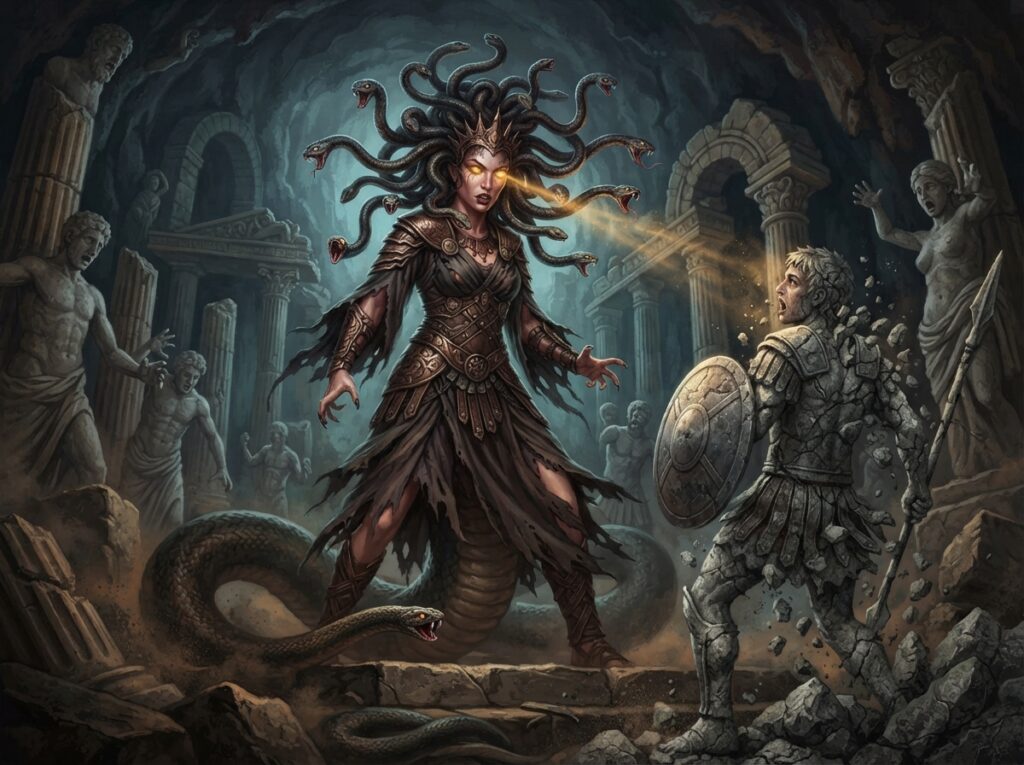
The goddess transformed the young priestess’s prized locks into a writhing mass of serpents. She gave her a gaze that turned any living creature to stone. The victim became the monster: weaponized, isolated, and ultimately hunted.
This is the version that has endured. And it is a version that feels, in Ovid’s own language, less like ancient myth than like a story ripped from a modern news cycle.
What Medusa’s name actually means: “Guardian,” not “Monster”
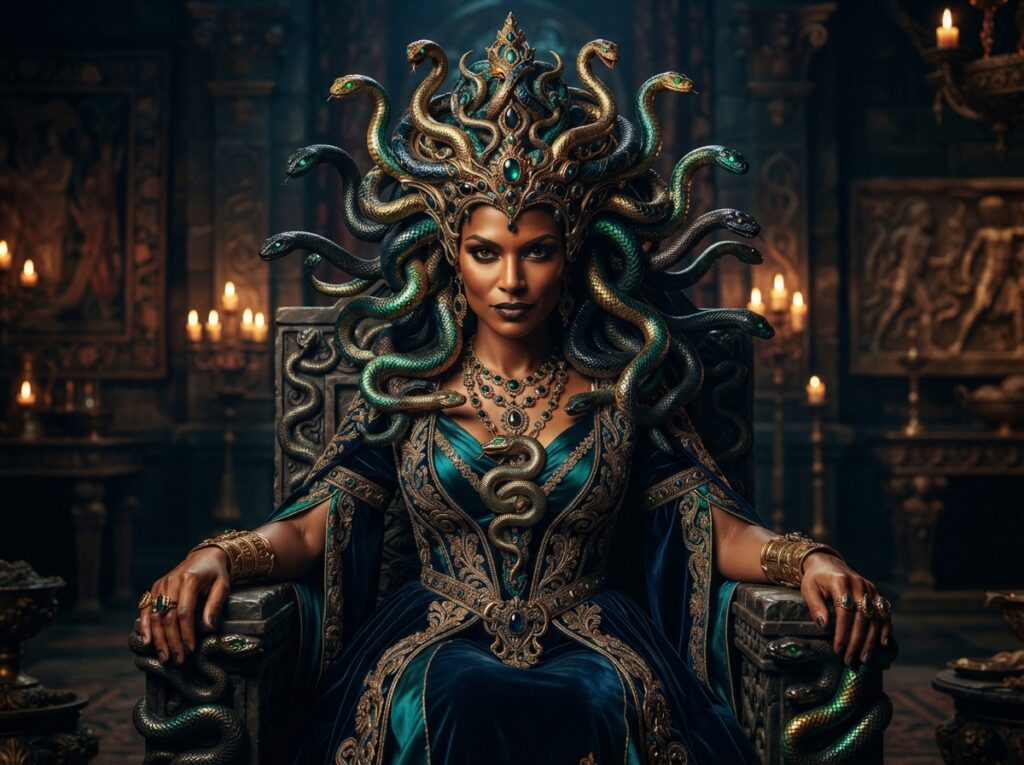
Here is an irony that cuts to the bone: the name Medusa derives from the Ancient Greek Μέδουσα, meaning “guardian” or “protector.”
She whose name meant guardian could not protect herself. She whose power petrified enemies was treated as the threat. In her name, the entire tragedy of her myth is compressed.
The Curse of Athena: A story of divine injustice
The scene Ovid describes in Athena’s temple is one of the most morally charged moments in all of Greek mythology. A god commits an act of violence in a goddess’s own sanctuary. The goddess, unable, or unwilling, to confront a fellow Olympian, redirects her fury downward. Onto the mortal. Onto the woman.
Poseidon, the Temple, and the punishment of the innocent
What makes Ovid’s account so enduring is its moral clarity or rather, its moral horror. A priestess, required by her sacred role to remain chaste, is violated in the goddess’s own house. The violation is not denied; it is simply redirected. The wrongdoer walks free. The wronged becomes the warning.
Scholars have noted that Ovid’s account “reads less like an ancient myth than a modern reality”, a framing that has resonated with readers across the centuries and today carries renewed weight.
Why Athena punished Medusa and not Poseidon
Some readings excuse Athena’s choice by pointing to divine hierarchy: she could not openly challenge Poseidon, a brother of Zeus. Others read it as a colder logic — the displacement of anger downward, onto the most accessible target.
What we know from Apollodorus is that Athena’s involvement did not end with the curse. She guided Perseus’s hand as he beheaded Medusa in her sleep, using a mirrored shield so he would not look directly at her face. And when it was done, Athena mounted Medusa’s severed head onto her own aegis, her war shield.
In other words, Athena punished Medusa, guided her death, and then wore Medusa as armour. It is a myth dense with contradictions, which may be exactly why it has lasted so long.
From apotropaic shield to pop culture icon: 2,600 Years of Medusa
Whatever her origin, Medusa’s image did not inspire only fear in the ancient world. It inspired protection.
The Gorgoneion: When Medusa became a protector
The Gorgoneion — the stylized image of Medusa’s face — became one of the most widely used apotropaic symbols in antiquity. Appearing on temples, shields, coins, amulets, and even children’s pendants, the image of Medusa was believed to ward off evil.
In a profound twist, the woman who had been victimized, cursed, and ultimately beheaded became a talisman of protection for the civilization that had mythologized her destruction. Even in death, Medusa shielded others — just not herself.
The Met Museum’s collection alone contains dozens of Gorgoneion artifacts spanning from 550 BCE to the early Roman period, tracking the evolution of her face from grotesque to strangely serene.
Versace, video Games, and the gorgon’s grip on modern culture
Medusa’s power over the modern imagination is hard to overstate. Versace built one of fashion’s most iconic logos around her face: a Gorgon rendered in gold, staring from belt buckles, scarves, and runway gowns. The message: beauty so powerful it stops you cold.
In gaming, Medusa appears as boss, playable character, and aesthetic shorthand for “dangerous woman with supernatural power” across franchises from Castlevania to Smite to Hades. In 2026, Halloween retailers are reporting a spike in Medusa costume searches, driven in no small part by the cultural energy around Greek mythology. The serpent crown is having a moment.
The greek mythology renaissance of 2026
If you’ve felt a shift in the cultural air around ancient myths lately, you are not imagining it.
What Nolan’s The Odyssey Means for Myth-Lovers Everywhere
Christopher Nolan’s The Odyssey (starring Matt Damon as Odysseus and featuring Zendaya in a key role) is one of the defining films of 2026. For audiences and critics alike, it has reignited a hunger for the raw, strange, morally complicated world of Greek epic. Nolan’s version leans into the ancient concept of xenia (divine hospitality), the savage caprice of the gods, and the long human cost of war and wandering.
Medusa does not appear in The Odyssey, she belongs to Perseus’s story, not Odysseus’s. But the halo effect is real. When one myth catches fire, the whole mythology lights up. Social media discussions of Athena, Circe, Medusa, and the Gorgons have spiked in the weeks since the film’s release. Greek myth is not a niche interest right now, it is the conversation.
Why we keep returning to ancient stories in times of upheaval
There is a reason ancient myths endure: they are not really about gods and monsters. They are about power, injustice, desire, and the stories we tell to make sense of the world. Medusa’s myth, a woman punished for what was done to her, hunted by the system that failed her, then repurposed as a symbol, resonates today with an immediacy that needs no scholarly footnote.
Reclaiming Medusa: The feminist reawakening of a misunderstood monster
In recent decades, Medusa has become one of mythology’s most reclaimed figures.
From Stone Blind to Circe: Literature’s new gorgons
Natalie Haynes’s Stone Blind (2022) retells the Medusa myth entirely from her own perspective, lingering in the ordinary life of a girl before the curse, the confusion and horror of transformation, the loneliness of a life spent knowing your gaze destroys. It follows Madeline Miller’s Circe (2018) in a growing tradition of feminist myth retellings that center the women Greek literature kept at the margins.
These books are not simply revisionist. They are asking the reader to sit with the original myth long enough to feel its injustice and to notice how familiar that injustice is.
The monster as mirror: What Medusa reveals about us
The feminist reading of Medusa does not flatten her into simple victimhood. She remains dangerous. She remains powerful. The point is that the power was always there, beneath the curse, beneath the monster-face and that the myth needed to make her monstrous before Perseus (and by extension, the audience) could feel comfortable with her death.
Medusa as monster is the myth’s comfort blanket. Medusa as a woman who was wronged, hunted, and then turned into a decorative piece on a goddess’s armour that version demands something more from us. In 2026, that version is winning.
Still Turning Heads
Nearly three thousand years after Hesiod first wrote her name, Medusa mythology refuses to calcify. She remains a creature in motion, across centuries, media, and moral frameworks. From Gorgon to guardian to feminist icon, she has survived every attempt to reduce her to a single meaning.
Christopher Nolan’s The Odyssey has reminded a new generation that Greek myth is not museum-piece material. It is live wire. And of all the creatures in that ancient pantheon, Medusa (complex, contradicted, impossible to look away from ) may be its most electric.
She always was more than a monster. It just took us a while to look back.
Enjoyed this deep dive? Explore our other articles on Greek mythology’s most misunderstood figures, the rise of monster-centric storytelling in modern fiction, and the creatures that shaped world folklore.